
Introduction Display Ads Users Campaigns Campaign Performance Campaign Priorities Inter Campaign / Creative Ad Placement Rules Pricing Reporting and Forecasting DMP Integrations Ad Networks & Ad Exchanges
Introduction
The purpose of this article is to bring anyone new to the on-line advertisement world quickly up to speed on concepts and terminology. All on-line advertisment related terms are given in italic. The referenced terms are used industry wide unless otherwise noted.
Display Ads
Below we see a typical on-line newspaper page with a news story to the left and an advertisment to the right. This kind of web ad that only shows a text string, image or flash file, is called a display ad. The company behind the on-line publication is referred to as the publisher. Publishers typically offer ad spaces on their web pages where advertisers can place their on-line advertisements. The ads are javascript tags with code that will interact with an ad server in order to obtain the visual ad that is to be shown.
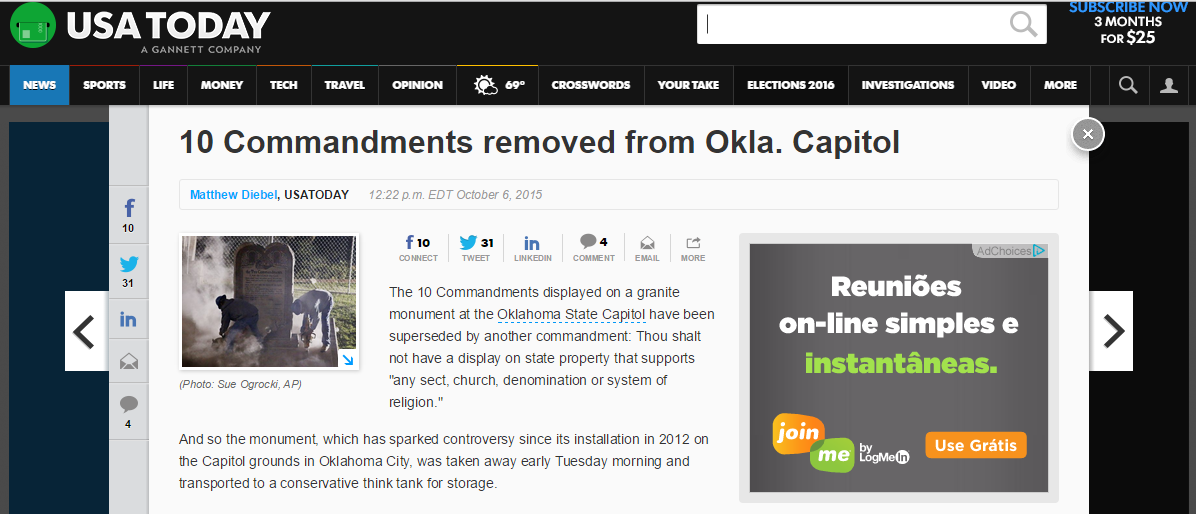
The physical ad itself is referred to as a creative and can be a text string, an image, a flash, an zip with HTML5 files, or a rich media ad (see next section). One ad may have more than one creative. Which creative that is to be shown in each case could be made dependent on the platform (computer, tablet, mobile) or by some other criteria/algorithm offered by the ad server serving the ad.
Rich Media Ads
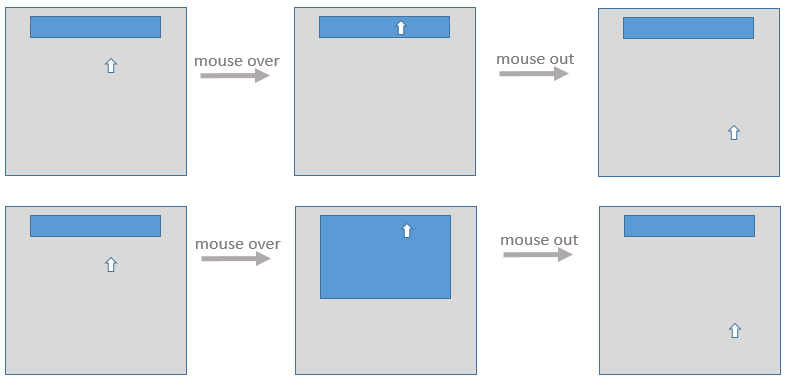
Unlike the display ad we saw in the figure above, a rich media ad is more complex and contains images and/or video and normally involves some kind of user interaction. Below we illustrate the difference between display ad (top row) and its rich media counter part (bottom row). Notice how a user interaction (in this example a mouse over) triggers an expansion in the case of the rich media ad, whereas the display ad remains the same as before.
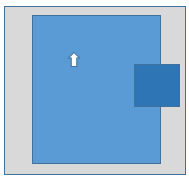
Even though rich media ads normally involve user interaction, it does not need to. Other non-standard features may still make it a rich media ad. Below we see a rich media ad that consists of a static flash and a static background image (a so-called skin). No user action will alter what is shown. However, due to the added complexity caused by the skin, it is still falls into the category of rich media ads.
The Interactive Advertising Bureau (IAB) has started standardizing rich media names so that publishers and advertisers world wide can refer to a particular visual effect by one and the same name.
Users
The person reading the web page and seeing the ad is called the user. Normally an ad server is unable to distinguish between a user (a person) and a browser. A person that uses more than one browser will normally appear as more than one unique user. The same goes the other way around. If two persons (for instance a husband and a wife) share a browser, then the two of them will appear as a single unique user. It is the browser cookie id that is normally used to identify the user. A cookie is a site specific small text file with key-value pairs that the browser store locally on the user's computer/device. One such key-value pair is the cookie id which is a randomly picked alphanumeric string.
Campaigns
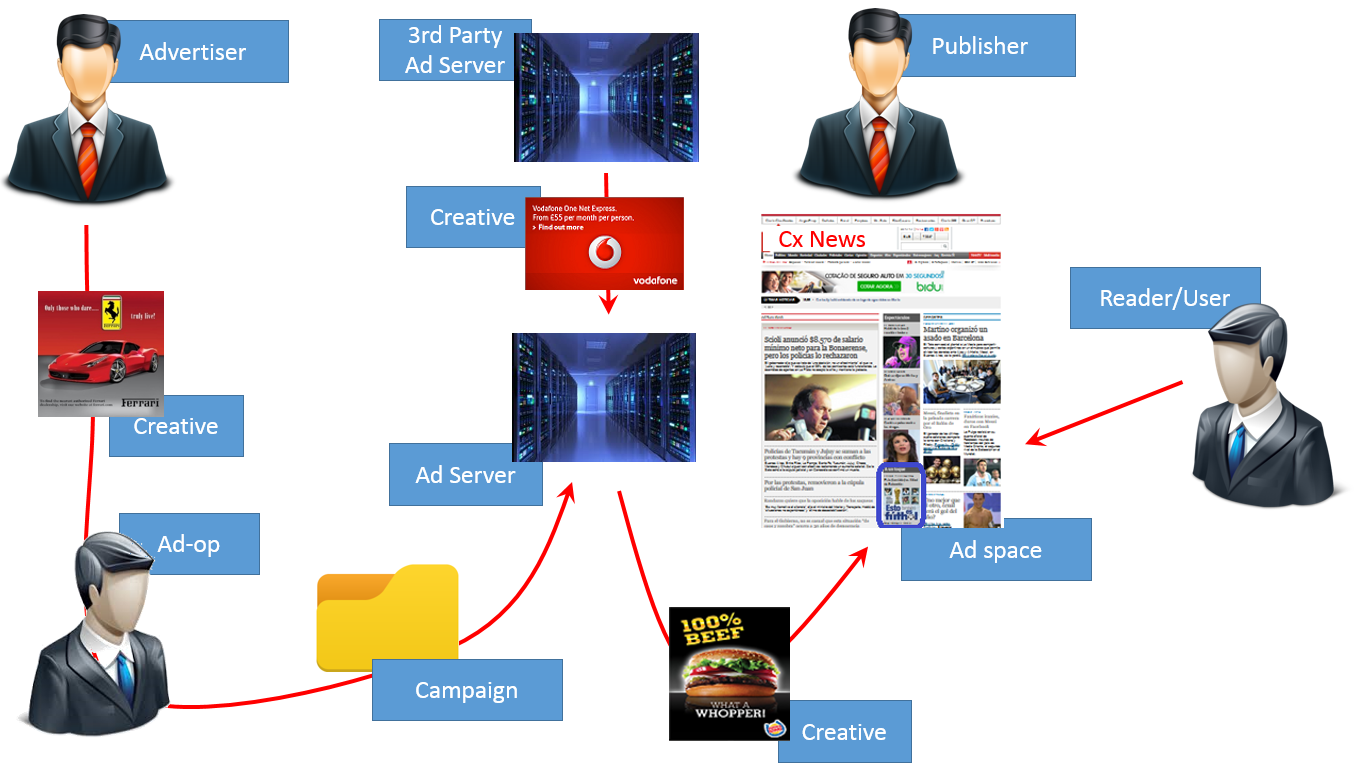
Above we see how an advertiser provides an creative to an ad operations team member (ad-op).The ad-ops are the ones that operate the ad server and create the ad campaigns of which the creatives are to be part. The publisher owns the publication containing the ad space into which the creative is to be placed. The ad-ops normally work for the publisher or for some first or third party organization representing the publisher. We also see that an ad can be from another ad server rather then directly from an advertiser. In that case we will be talking about third party ad servers and third party creatives. A reference to a third party ad tag will be included within the regular ad tag in order to retrieve the third party campaign creative stored on the third party ad server,
Beyond the creative(s), a campaign also has the following settings:
-
Flight dates - the period the campaign is to run
-
Priority - when / if the campaign creative(s) is/are to be shown due to / relative to other campaigns
-
Targeting criteria - to whom and when the creative is to be shown (for instance only in the morning and then only to people in Oslo that is accessing the publication via their mobile phone)
Campaign Performance
When an ad is placed (displayed) on a page, that is referred to as an impression. If someone clicks on it, then that is referred to as a click. The percentage of clicks relative to impressions is referred to as the click-through-rate (CTR). If a user clicks on an ad and then follows that up with some advertiser defined desired action (for instance a purchase), then that is referred to as a conversion. Sometimes there are several steps from the first click on the ad until the conversion is complete. For instance, if the ad is for an university enrollment, then there might be several forms to fill out before one come to the final page where one upload the study application. Such a series of steps is called a conversion funnel. The name stems from the idea that for each step you are likely to loose a few (just like a funnel gradually narrows). If a conversion entails to click on something, then that is referred to as a post-click.
Campaign Priorities
In order for the ad server to know which ads to show first, campaigns are given priority levels. Ads from a campaign with a higher priority level is served before ads from a campaign with a lower priority. It is also not uncommon to have sub priority levels for a even finer division. How many ads that are to be shown by the highest priority campaign before ads from the next priority level, is determined by campaign weights. A campaign weight of 100% means that a campaign will display all booked impressions before letting the next level campaign show it's first one. A weight of 90% would let one in ten impressions be passed on to lower priority campaigns.
Inter Campaign / Creative Ad Placement Rules
Sometime an advertiser have several ads that plays together in some way (for instance a top bar and two side bars producing some combined visual expression and one not being there will ruining all) and wants to occupy all ad spaces on a single web page. Sometimes there is the opposite situation when it is important that two types of ads are never shown together on the same page (for instance one ad for Nike shoes next to another ad for Adidas shoes). We refer to this as inclusivity and exclusivity respectively. Depending if this is done at campaign or creative level, this is referred to as campaing inclusivity/exclusivity or creative inclusivity/exclusivity.
Pricing
Ad spaces are normally sold according to these pricing prinsiples:
-
CPM - the advertiser pays a price per thousand impressions (Cost Per Mille impression - mille is Latin for thousand and M is also the letter used for thousand in the Roman number system)
-
CPC/PPC - the advertiser only pays per click (Cost Per Click / Pay Per Click)
-
CPA - the advertiser only pays if some action take place (Cost Per Action). The action is typically a conversion of some kind.
-
Tenancy - the advertiser pays a fixed price for occupaying an ad space permanentley within a defined time period, for instance a day or a week. The term tenancy is taken from the old style paper classified ads and may not be understood in the same way outside the Cxense Advertiser product..
-
RTB - Real-time bidding is an auction based system where advertisers bid for impressions and/or clicks programmatically in real time. Who wins a bid should not necessarly be decided by who offers the most. For instance, a high price for a click that hardly ever take place results in less overall revenue for the publisher than a low priced bid for a click with high frequency. Ad servers that offers RTB normally provides a set of alternative algorithms of which highest bid could be one and highest publisher revenue another.
Reporting and Forecasting
Most ad servers provide reports and forecasts functionality. Reports normally reports on the number of delivered impressions and delivered clicks for each campaign (advertiser reports) or ad space (publisher reports). Forecast are used to ensure that one does not overbook (sell more impressions and/or clicks than what will be available) and then under deliver. Forecasts that are used by the sales force to avoid overbooking is often referred to as availability reports. The available number of impressions and clicks to be sold is referred to as ad inventory.
The speed by which a campaign display ads is referred to as the burn rate. A too high burn rate will cause a campaign to run out of purchased impressions or clicks before the campaign end date is reached. For some campaigns this is not a problem, but for those that it is one can apply a smoothing algorithm and/or daily capping. The latter runs full throttle until some daily impressions cut-off number is reached whereas the former tries to spread the number of impressions evenly out accross the whole campaign period. The is also referred to as a paced campaign.
DMP Integrations
It has become very common to integrate ad servers with DMPs (Data Management Platform). A DMP is a data warehouse that in theory can store any kind of data, but that in reality almost always stores user (browser) cookies organized into audience segment. An audience segment is a group of users (browsers) that fit some filtering criteria such as for instance "women from Alaska using a SonyEricsson mobile" or "men under 30 that read at least 30 pages of sports articles during the last week". These DMP audience segements can then be used for campaign targeting by the ad-ops. (The examples given assume that gender and age information from the publisher's CRM system has been uploaded to the DMP, something which is not an uncommon thing to do if such information is available).
Ad Networks & Ad Exchanges
A company that connects advertisers and publishers so that the advertisers can place ads in publisher's ad spaces (on-line or traditional media) is called an ad network. If the ads are on-line ads, then the ad network will use an ad server to serve their publishers and advertisers. Hence, another way to say it is that a company that operates an ad server is an ad network.
In the beginning of on-line marketing, ad networks used to be independent of the publisher. The trend now is that publishers, especially the big ones, more and more starts to operate as their own ad network. Such ad networks are called PCANs (Publisher Controlled Ad Networks). Sometime you will see PCANs referred to as first party ad servers and and independent ad servers as third party ad servers.
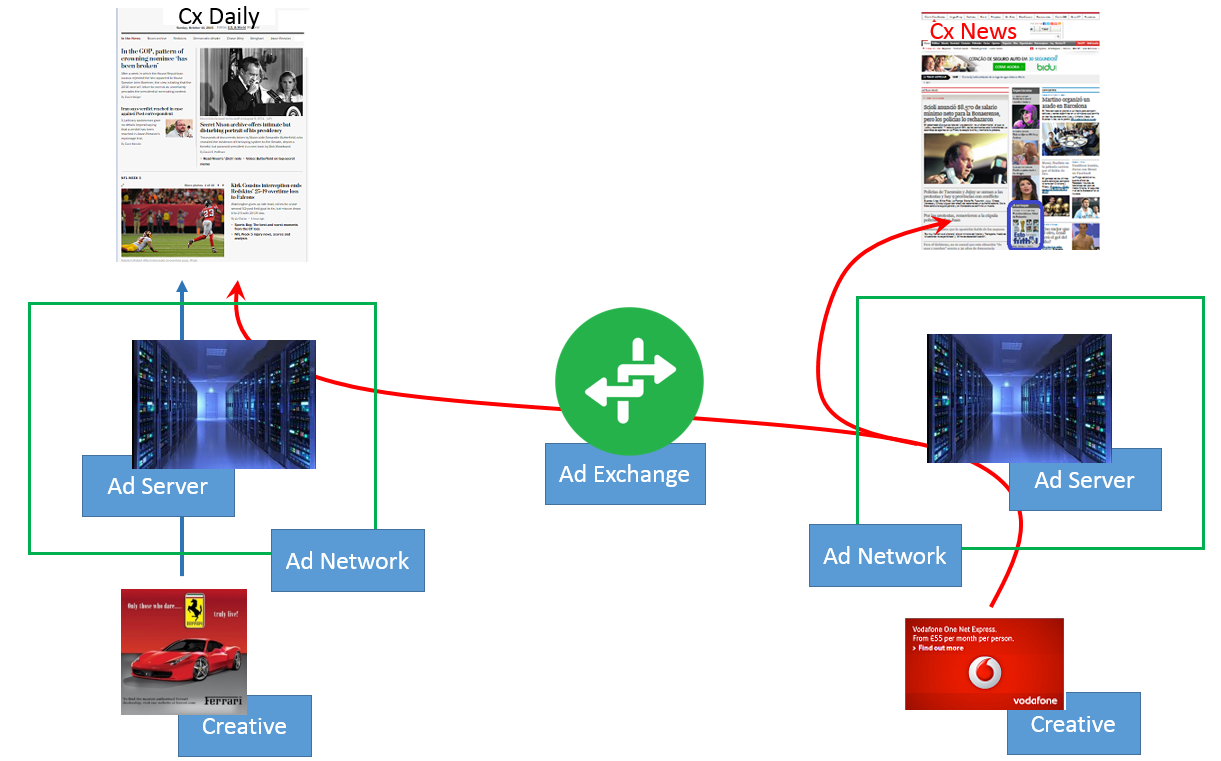
An ad exchange facilitate programmatic bidding and trading of ads among ad networks. In the figure above we see how an creative part of an ad campaign registered with one ad netowrk's ad server can end up either being displayed in a publication directley related to that ad network or end up being sold to another ad network and being placed in one of their publications.
An ad exchange is an automated marked place for the trading of ads and ad spaces. An ad exchange consists of an ad space selling side called SSP (Supply Side Platform), and an ad space buying side called DSP (Demand-Side Platform). The two sides speak with each other according to a real time bidding (RTB) protocol. The left most reaching red arrow in the graphic above shows how a creative provided by the ad server to the right is be placed in an ad space provided by the ad server to the left. This happen when a user visits the publication Cx Daily and the ad space on the visited page is auction off and sold in real-time via the Ad Exchange's SSP to the best paying of the DSP connected ad servers.