
Collecting data using a DMP is one of the most useful features it offers, enabling the creation of high-quality audience segments for various online and offline marketing and advertising purposes. However, proper data collection is crucial to achieving these goals.
Although data collection occurs at the outset, it plays a critical role in subsequent stages, namely segmentation and data activation. The data captured by a DMP can be classified into four categories:
-
web and app data
-
first-party system data
-
marketing and advertising campaign data
-
second- and third-party data sources (e.g. data from partner sites or providers)
The first-party system data is particularly valuable as it might contain sensitive customer information from both online and offline systems like CRM and transaction systems.
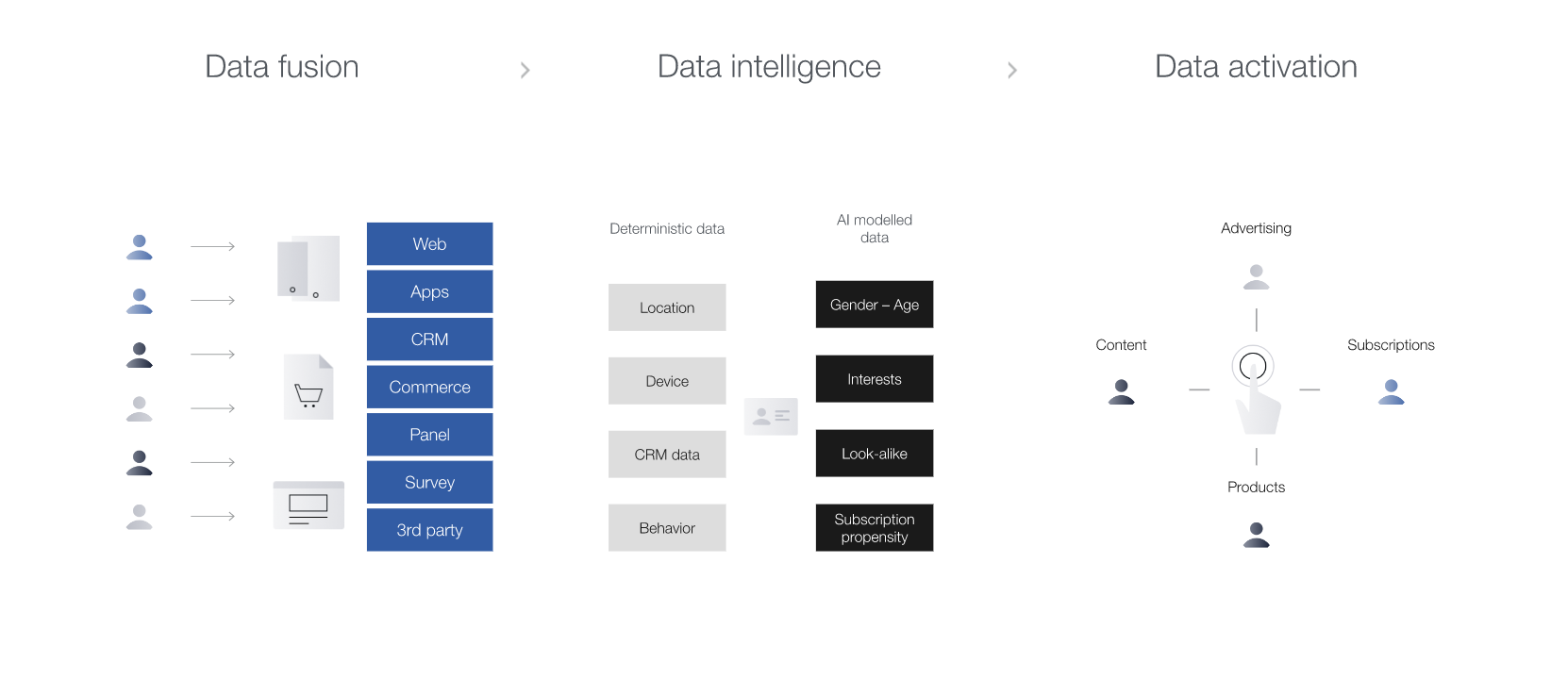
Data Collection and Fusion
DMPs and CDPs use various methods to collect data, such as tags, server-to-server integration, and APIs. For instance, tags can be used by a publisher to send website data to their DMP, while an e-commerce store can send customer data from their marketing automation platform to their DMP through API.
Apart from these methods, first-party data onboarding is another way of collecting and importing data. In addition to collecting first-party data, DMPs and CDPs may supplement company data with third-party audience data and location information provided by data suppliers.
These third-party data can be leveraged for behavioral analysis and lookalike modeling to identify audiences who share similar qualities and behavioral patterns that align with the company's objectives and most profitable target audiences.
Creating a User Profile
Creating user profiles is a crucial step in the data collection process as it involves transforming the collected data into events and profiles, which serve as the foundation for audience segmentation.
An important part of this stage is ensuring that the datasets are aligned with common identifiers, such as matching a (hashed) email address from a CRM system with one from a marketing automation platform.
By doing this, events and attributes that are related can be combined into a single profile, eliminating any duplicate profiles.
While data activation is an important aspect of a data strategy, it's only part of the equation. Duplicate users and incomplete profiles with few attributes can hinder the effectiveness of audience segments, resulting in suboptimal outcomes. Therefore, it's important to ensure the quality of the data and completeness of profiles for successful data activation.
Data import to Piano Audience
Methods for importing data to Piano Audience are described here.
Piano offers out-of-the-box connections with identity platforms such as ID5 to prepare for the end of 3rd party cookies. Piano First Party Data Acquisition (FPDA) refers to a set of features that, together, address the deprecation of third-party cookies announced separately by Apple, Mozilla, and Google. FPDA does not refer to a single product or license but instead is used to reference the features across existing Piano products that solve this problem.
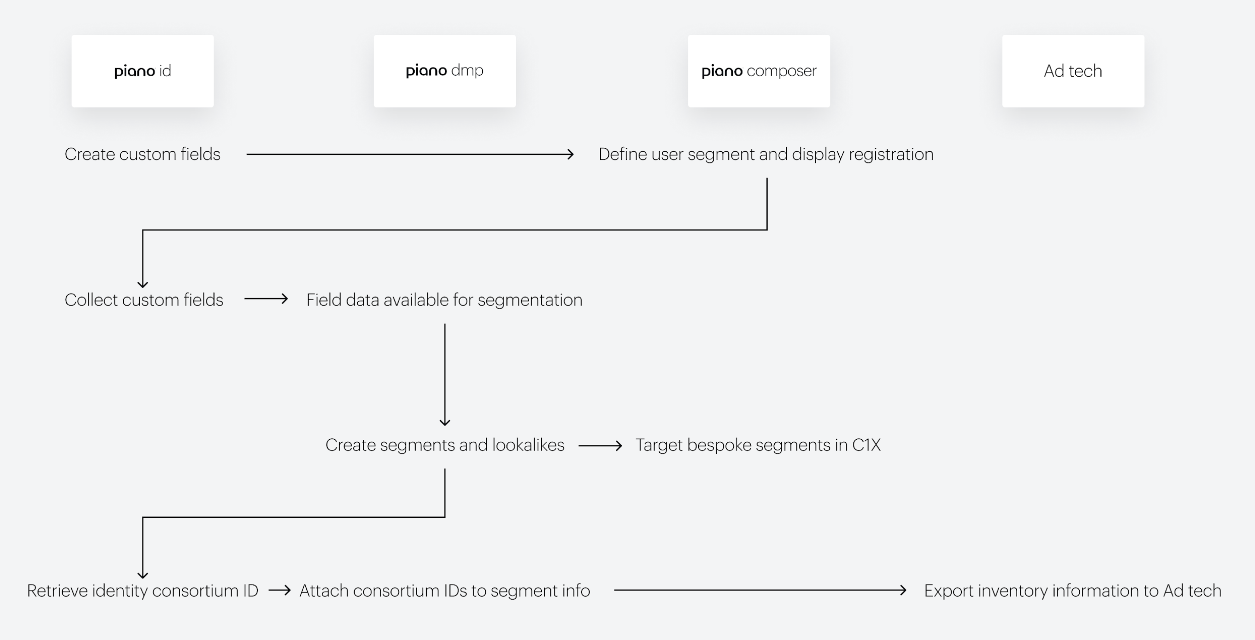
Sending Data from Identity Management to Piano Audience
You can send custom field data to Piano Audience in order to enrich user profiles and improve targeting. This way, publishers can gather additional data on their users and improve the accuracy of their audience segmentation and targeting.
Here you can find instructions on how to send Custom Field data to Piano Audience.
Sending Data from Piano Audience to Composer
You can integrate Piano Audience with Composer, a tool for creating and managing personalized experiences for website visitors. This will offer better audience segmentation and targeting and allows you to use data from Audience in Composer to personalize content and experiences for individual visitors.
Under the following link, you can find more information on how to set this up.
Data Standardization and Intelligence
After collecting data, it should be standardized. This process may involve the following steps:
-
Capturing IDs
-
Removing unnecessary or unusable data
-
Mapping the data schema of the source to the DMP's/CDP's data schema
-
Enriching the data with additional data points like geolocation and OS/browser attributes
Data enrichment provides two important advantages:
-
Different data sets are structured in a standardized format
-
Data quality and value are improved
During this process, a unique ID and various pre-defined attributes are assigned to each user, which will play a crucial role in the segmentation stage.
These attributes can include:
-
Age
-
Gender
-
Location
-
Browsing history
-
Interests
-
Order history
Progressive Profiling
This article provides a step-by-step guide on how to implement progressive profiling on a website, a process that enables businesses to collect user information gradually over time through a series of forms. This can help reduce user friction and increase the likelihood of users completing forms, while also providing businesses with more accurate and valuable user data. It includes best practices for designing and implementing progressive profiling forms, including the use of conditional logic, identifying key user attributes, and using personalized messaging to increase engagement.
Data Activation
Activating data involves using customer data to gain insights and take action, and it is a crucial step following data collection and management. To activate data, you can leverage various tools such as ad platforms like Facebook Ads and Google, customer support platforms, email marketing platforms, analytics and business intelligence (BI) tools, personalization software, and CRMs. In the Piano world, this includes targeting users via Composer or collecting data via Identity Management Custom fields.
Data activation enables businesses to utilize data according to their specific needs, making it more actionable and usable for their teams. This approach helps to target different user groups at various stages of the sales funnel, resulting in a better understanding of how to link their efforts to business outcomes.
With access to various sources of information, you possess the ability to identify crucial patterns in the behavior of your website's visitors. This includes the capability to compare and bring to the surface shared behaviors and characteristics of particular customer groups, as well as predict their behavior.
By leveraging this knowledge, you can identify customers and prospects who may require your attention and concentrate your efforts on activities that are likely to yield the best outcomes. For instance, you can concentrate on identifying sequences of actions that precede conversions, upgrades to higher pricing plans, or churn, and then urge customers to take specific steps to steer them in the desired direction.