
Propensity to Convert
The propensity to Convert is a Machine Learning model that indicates how likely a user is to convert to a subscription on a scale from 0 to 100. Different readers on a site have different level of interest to subscribe, thus to drive more subscriptions you may want to provide different campaigns to different visitors to ensure that their site experience is relevant experience and engaging. The model is run and trained on your data utilizing our real-time capabilities, meaning that the Propensity to Convert model available in you CCE GUI is unique for your audience. Further, as the user score is based on real-time data any user that change behavior and indicate a higher interest in subscribing will automatically change score. This feature ensure that you always will target the intended audience with your campaigns with no need for manual changes.
In the the CCE GUI the propensity model to convert are seen in the first step "Audience" when you create a new campaign.
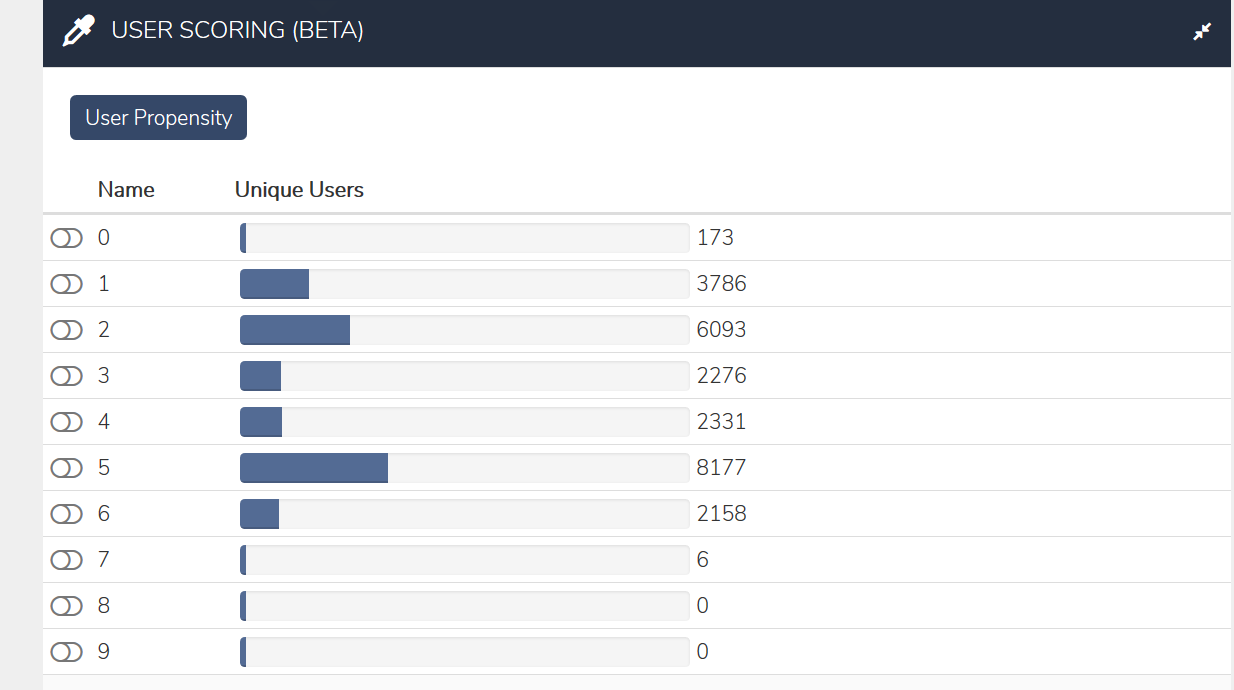
The Conversion propensity score are presented in buckets indicating their likelihood to subscribe from 0-10. Bucket 0 includes the users with score from 0 to 9, bucket 1 – 10 to 19, etc. The bar to the right contains the estimated number of users that have been assigned to this bucket: that is, how many ended up there during the last run of the model on a test set from the recent past.
How does it work?
Once a week a Machine Learning model is trained to predict how likely users on the site are to subscribe.
Training essentially means this:
-
Look at unregistered users versus recent subscribers;
-
Compute a lot of various potentially important behavioral characteristics in each user's past;
-
Use machine learning to determine the best way to predict the likelihood of subscription based on those characteristics.
The characteristics includes amongst other; number of page views, number of articles read, bounce rate, number of active days, and most read topics. Combined with different time periods in the user's history, the total number of features considered for each model is around 100. During the machine learning phase ~50 most informative ones are selected to avoid accidental correlations and make the model more robust. Every time a visitor on the site is targeted by a campaign that involves the propensity score, their propensity score is computed in real time, based on the latest trained model.
What is required to make it work on a site?
For at least 30 days the subscription action that you want to predict has been triggering a conversion event (see Product Conversion Tracking - Implementation Guide). A good amount of correctly labelled input data is the most important thing for the propensity scoring to give results, so the modelling starts only if there are >100 conversion events in the past month on the site.
If this requirement is fulfilled, it takes under 7 days for all components of the propensity scoring system to start. Please contact your Cxense customer success manager or Cxense Support if you experience any problems.
FAQ:
-
Is the model specific to my site?
Yes: models are trained individually for each site. -
How often is it trained?
Training is once per week. Prediction is real-time. So, each prediction is based on the user's history up til right now, and the statistical insight that is no older than a week. -
Why do some users not get a score?
Users don't get a score if we don't have any events from them (no consent or first-time visit), or if they have so many events that they're most likely a bot. -
How accurate is it?
The quality depends on a lot of different things: amount of training data, types of subscription offers, etc. On large datasets the model has succeeded in recognizing up to 80% of future subscribers. But even in the worst case scenario it performs better than simply targeting the users with the most clicks.