
The click.campaign.offsite event counts the clicks on your marketing campaigns. Piano Analytics generates it automatically whenever a page.display event contains the src_campaign property. A campaign on a page load implies that someone clicked a link to reach your site, even if that page isn't the entry page of the visit.
The event gets a Visitor ID, so you can segment visitors on it, but it doesn't get a Visit ID. Analyze it on its own, to see which campaigns contributed to access to your site.
For example, a visitor arrives on page A through Direct access. A few minutes later, they click a sponsored link that takes them to page B. Piano Analytics generates a click.campaign.offsite event at the same time as page B loads.
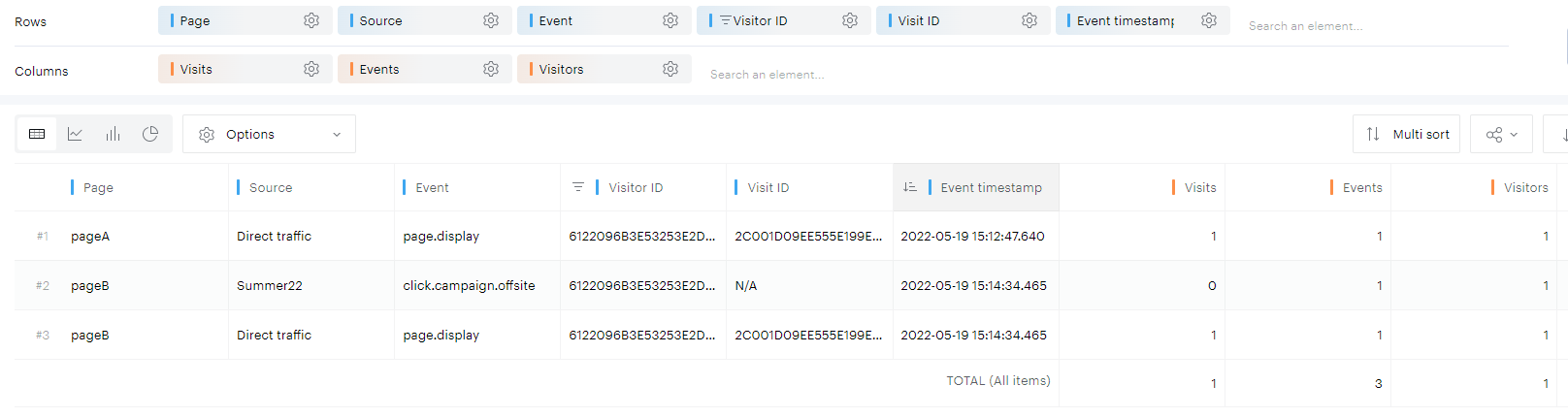
Why the event has no Visit ID
A visit has only one traffic source, which is determined at the start of the visit by its first event, typically the first page.display. If Piano Analytics meets campaign parameters later in the same visit, it records them as click.campaign.offsite events without changing the source of the visit. As a result:
-
The event increases Events, and can increase Visitors.
-
The event doesn't increase Visits and doesn't carry visit-scoped properties, because it has no Visit ID.
This design lets you track marketing touchpoints that happen during a visit while keeping the source of the visit correct.
Relationship with page.display
Piano Analytics creates click.campaign.offsite during processing, from a page.display event that contains campaign information. In practice, the two events:
-
usually share the same timestamp, because they come from the same page load.
-
happen together when a tracked landing URL loads.
If you see click.campaign.offsite events with no matching page.display in the same timeframe, there may be a collection or analysis issue worth investigating.
Multiple events for one visitor
It's normal to see several click.campaign.offsite events for the same visitor, including in a single visit. As long as the visit is active, meaning less than 30 minutes of inactivity by default, each page load with campaign parameters can generate a new event. This commonly happens when a visitor arrives from one source, for example Direct, then clicks one or more tracked marketing links and comes back to your site within the same visit.
Analysis of the event
Because the event has no Visit ID, analyze it separately from visit-based reporting:
-
Use Events to count the total campaign clicks recorded by this mechanism.
-
Use Visitors to count the unique visitors who generated at least one
click.campaign.offsite.
If your analysis is about visits, such as entry pages, bounce rate or time spent, exclude the offsite events. A common way is to keep only the rows where Visits is greater than 0, or to explicitly exclude the click.campaign.offsite event.
Visit-scoped properties, such as Entry page and similar entry or visit fields, can show N/A for this event. This is expected, because these properties need a Visit ID.
Troubleshooting
-
More visitors than visits for a campaign: this is usually because
click.campaign.offsiteis included in the analysis. The event counts visitors but not visits, so mixing it with visit-based reporting creates apparent differences. -
Event counts differ from page.display counts: often, each tracked page load produces both events, so the counts look similar. They can differ, for example if processing excludes some
page.displayevents, such as identified bot traffic, while the derived click event stays. In that case, the difference is expected. -
Disabling the event: you can't. It's part of how Piano Analytics processes and shows campaign interactions and attribution. If you don't want it in certain reports, exclude it in your analyses or create views that hide it.