Nativo is a supply-side platform (SSP) allowing publishers to offer their available inventory to ad exchanges and demand-side platforms (DSP)s. With this integration, Piano Audience segments can be used in Nativo SSP.
Prerequisites
Before the activation of the export connection, you should contact Piano's Support or Tech Consultant team to learn your customer ID. Pass 1) this customer ID along with 2) the customer name of your new Audience-Nativo integration to Nativo support (dmpsupport@nativo.com).
Setting the CookieSync tag
Nativo and Piano Audience have a server-side integration. User ID mapping is stored on Piano Audience's side. Membership data will be uploaded to Nativo on a schedule - once a day. You need to decide which tag is more convenient for you and put it on all the websites of your network.
Synchronous tag
<script type="text/javascript" src="//cdn.cxense.com/cx.js"></script>

   <script type="text/javascript">

       cX.sync('ntv');

   </script>
Asynchronous tag
<script type="text/javascript">

      // Async load of cx.js

       (function(d,s,e,t){e=d.createElement(s);e.type='text/java'+s;e.async='async';

       e.src='http'+('https:'===location.protocol?'s://s':'://')+'cdn.cxense.com/cx.js';

       t=d.getElementsByTagName(s)[0];t.parentNode.insertBefore(e,t);})(document,'script');

       var cX = cX || {}; cX.callQueue = cX.callQueue || [];

       cX.callQueue.push(['sync','ntv']);

   </script>
Configuring Piano Audience
-
Create a configuration
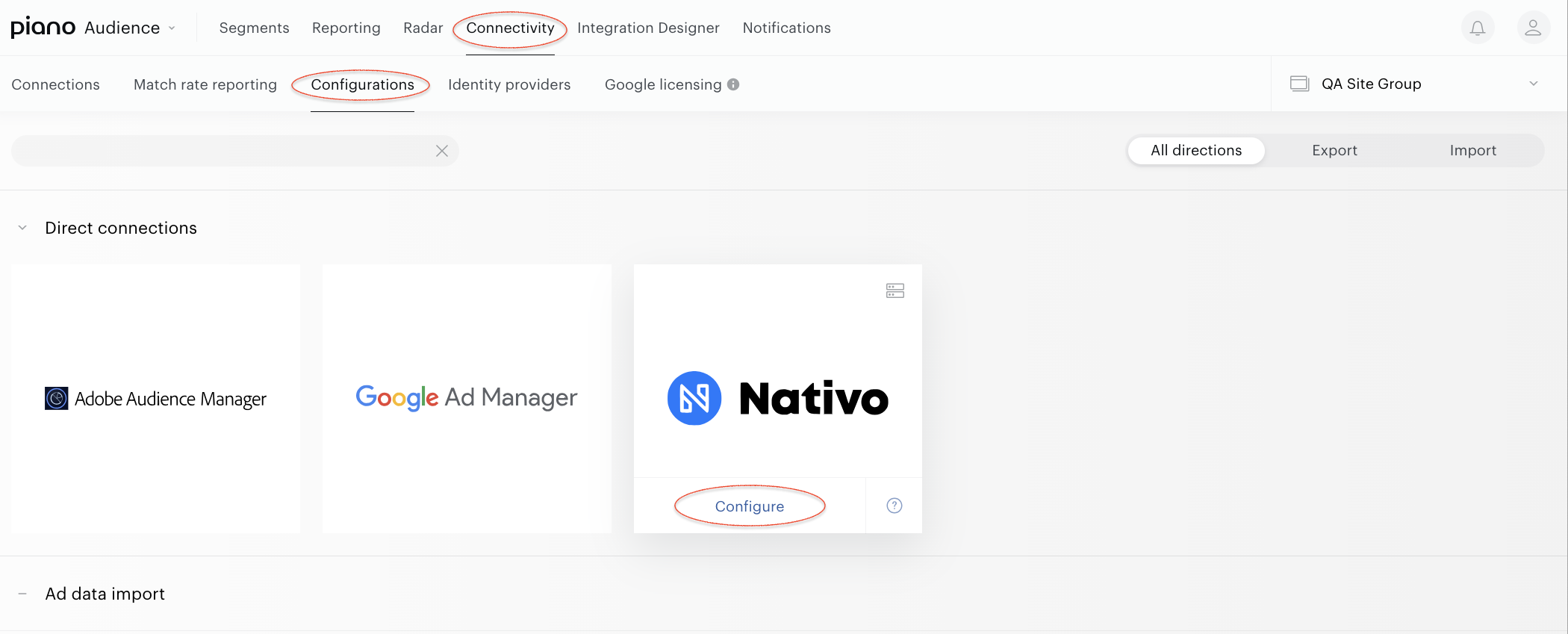
With your site group selected, from the Piano Audience home page, go to the Connectivity tab → the Configurations tab →the Nativo icon; click the Configure button.
-
Configure the connection
Define the project name; it will be shown only in Piano Audience to simplify managing numerous integrations.
Click the Create button in the upper right corner.
-
Configure segments
Successful test connection enables the Configure segments form where:
-
All full usage segments means that all active full usage segments will be sent to Nativo; any newly created active full usage segment will be added automatically.
-
All segments includes both types of usage segments: Full and Reporting only segments.
-
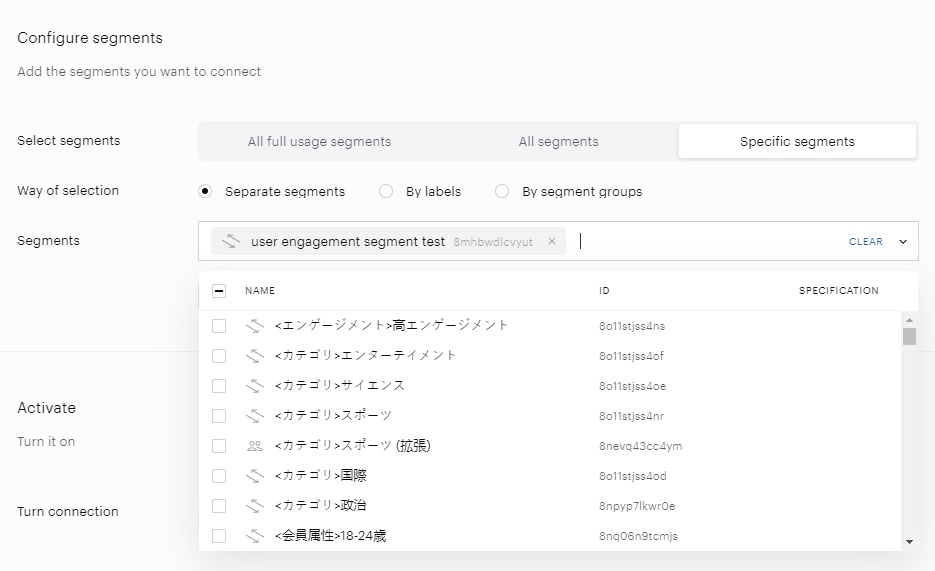
Specific segments allow the customer both to send some part of the active segments and to check if a needed segment is active now. If a needed segment is inactive, it can be activated on the Segments tab.
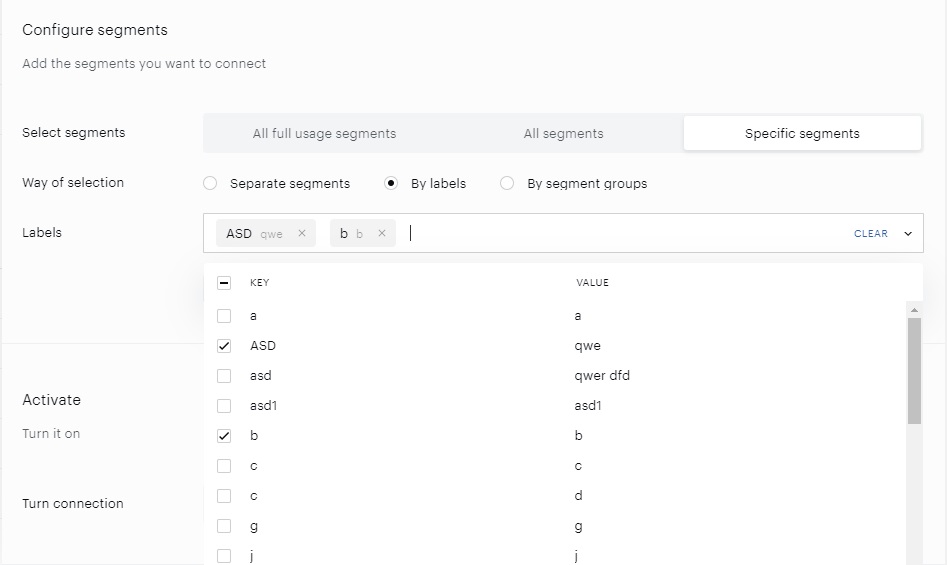
Specific segment options allow the customer to choose how exactly Audience should select segments for export:
-
Separate segments allows the customer to search and select segments one by one manually.
-
By labels allows the customer to select one or more labels (key-value pairs). Audience will find segments by the selected labels and export them.
-
By segment groups allows the customer to select one or more segment groups, and Audience will export segments within these specific segment groups. It is more suitable for those clients who prefer to organize their segments specifically.
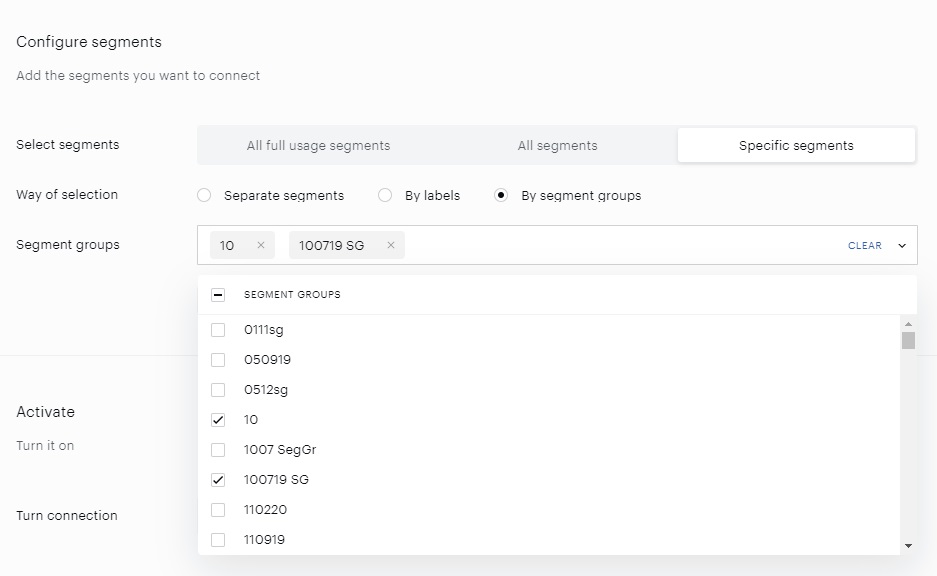
Set the parameter.
-
Export segments
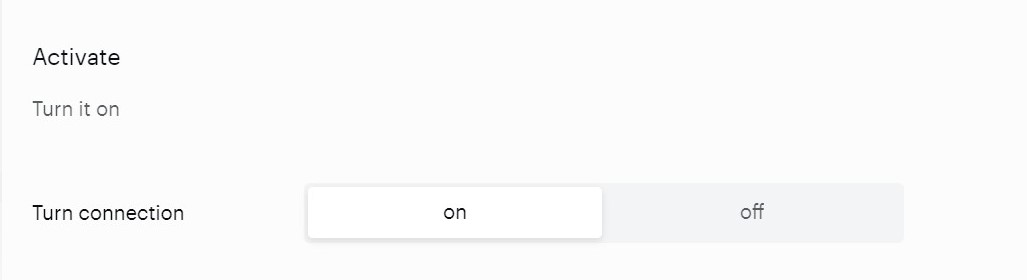
The other option is configuring scheduled data transfer in the Activate section. There, you can either set up daily data transfer by turning the connection on or hold the created configuration without activation yet and set the connection to off.
When ready, click Create or Save (if editing) in the top right corner of the page.
Monitoring and update
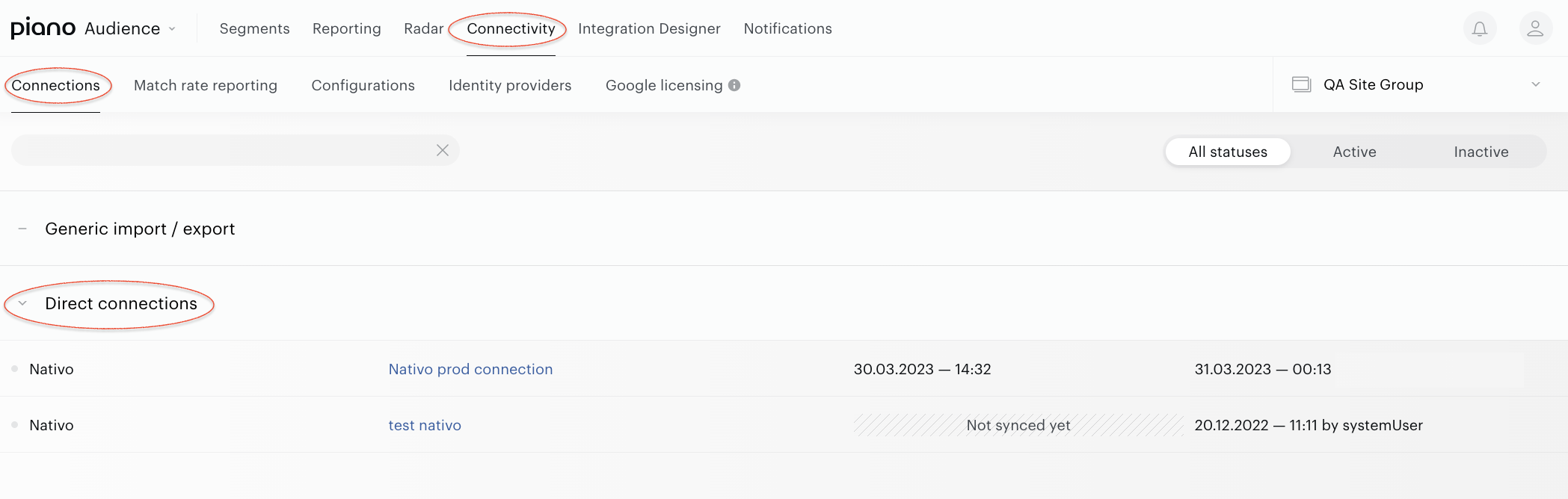
Configured connections can be viewed and edited on the Connections tab. They are also available under the Match rate reporting tab. Data is normally exported once a day.