
Segment Auto-Deletion
Overview
All Piano Audience customers have a certain Limit of segments that can be created for specific site groups. By default, it amounts to approx. 200 segments and covers Full usage segments.
When reaching the limit, you can prevent the accumulation of obsolete or unused segments (like segments with zero audience) by periodically deleting them.
Piano Audience allows to delete segments in the following ways:
-
Manually, one by one in the Segment List or using the Segment Builder.
-
Manually, using the Delete bulk operation. The customer can select multiple segments and delete them simultaneously.
-
Using API endpoints. This option is available only for admins.
-
Automatically, based on the site group settings or the Expiration date parameter. Read details below.
Auto-deletion per site group
For auto-deletion per site group, follow these steps:
1. Go to the Accounts Management application.
2. Open the Site groups tab.
3. Open the site group builder to create or update a site group.
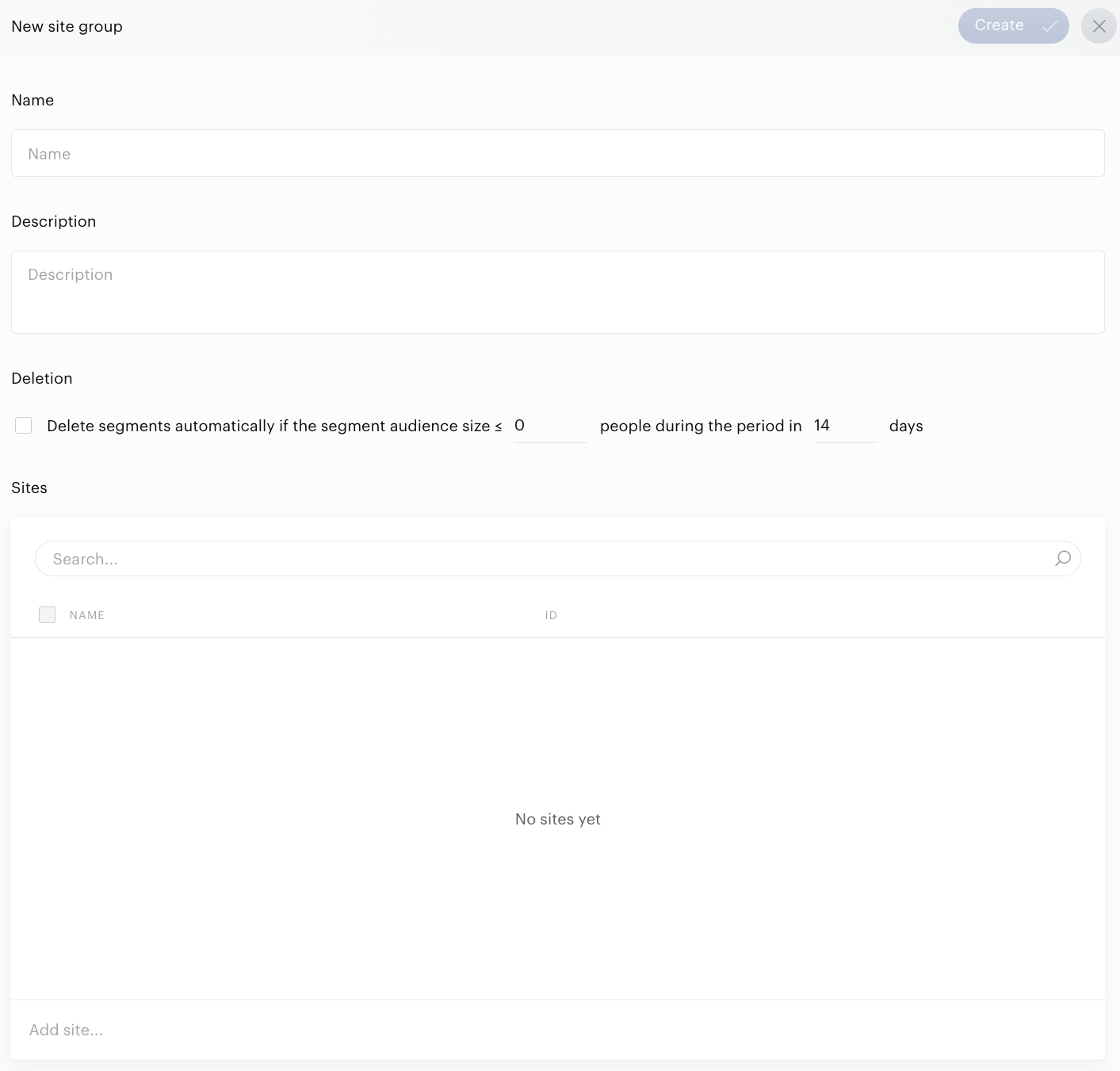
4. Enable the Auto-delete function by selecting the Deletion checkbox. Specify the audience size limit and the amount of time (in days) an audience must be within the specified limit before segments can be deleted automatically.
5. Activate the Update related segments checkbox to enable the option which leads to updating and/or deleting related segments in case of automatic deletion. The checkbox is available for editing if the Delete segments automatically… checkbox is enabled.
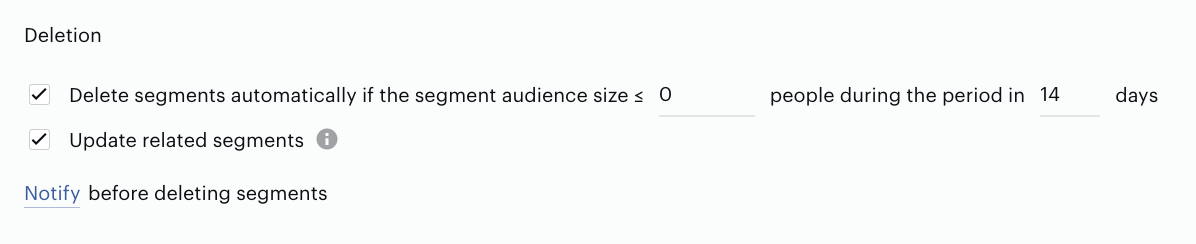
If you do not activate the Update related segments checkbox, Piano Audience will automatically delete only segments without any related segments.
6. Save changes.
What kind of segments can be deleted if the function is enabled?
Basically, customers can automatically delete all segments that can be deleted manually, except for External segments (this option can be added later).
The following segments can’t be deleted by the customer manually or automatically:
-
Segments with non-Custom category such as Interest, Age, Gender segments.
Only admins can manage the auto-delete function per site group. This function can be enabled or disabled any time.
If the function is enabled, the customer can activate the associated event in Subscriptions and receive notifications before the deletion. Just click on the Notify… link or open the Subscriptions tab.
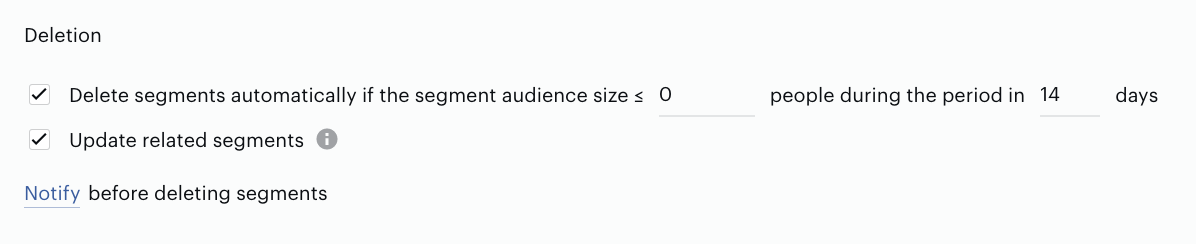
The email will include a list of segments that can be deleted automatically in, for instance, 3 days.
Read details about notification events here.
Auto-deletion using the Expiration date parameter
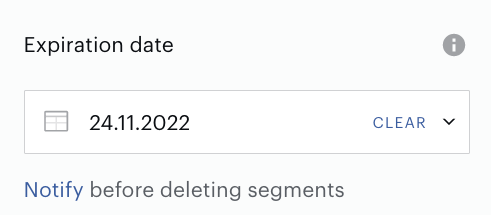
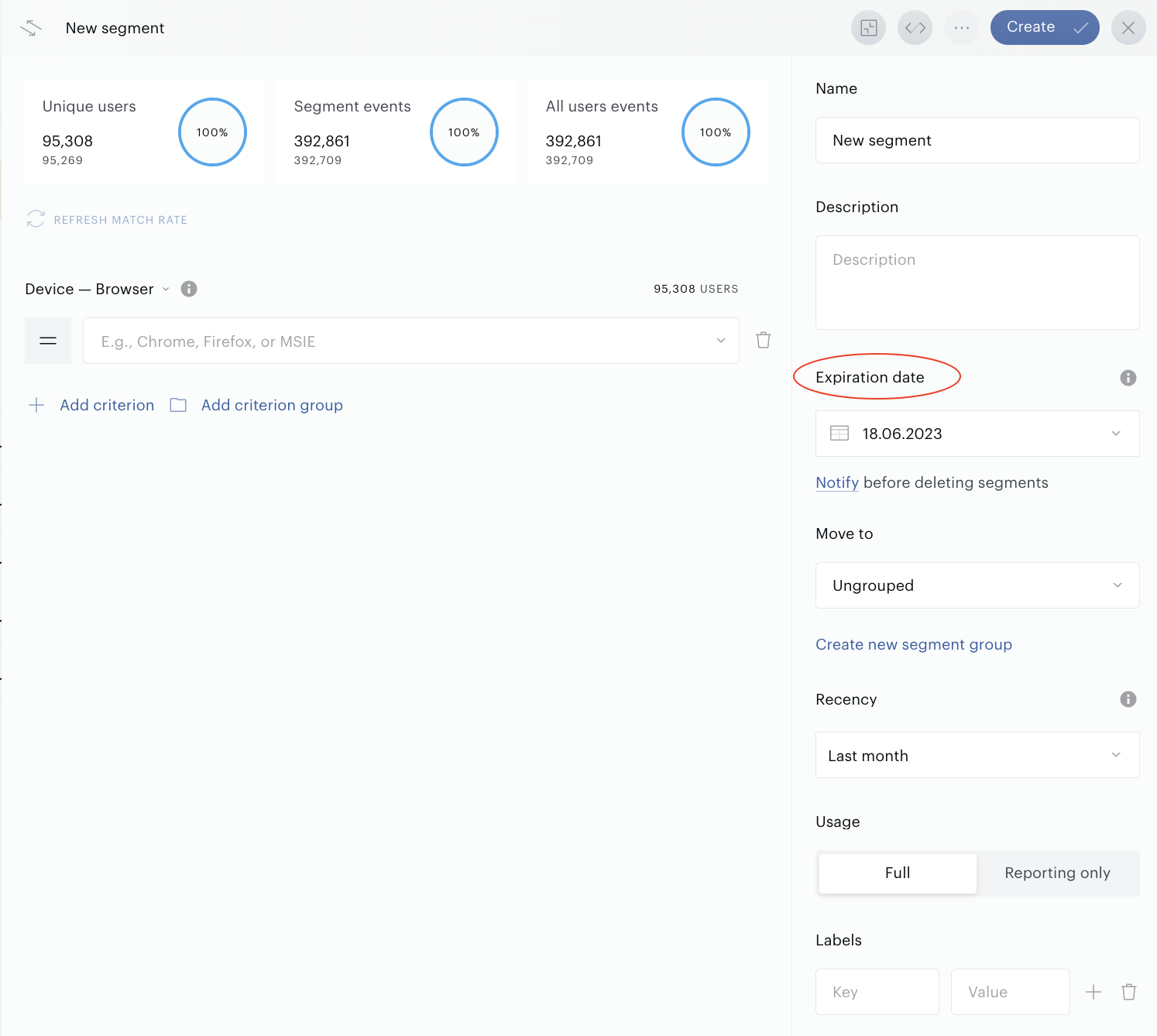
One more option that allows customers to delete segments is using the Expiration date parameter that is available in the Segment Builder:
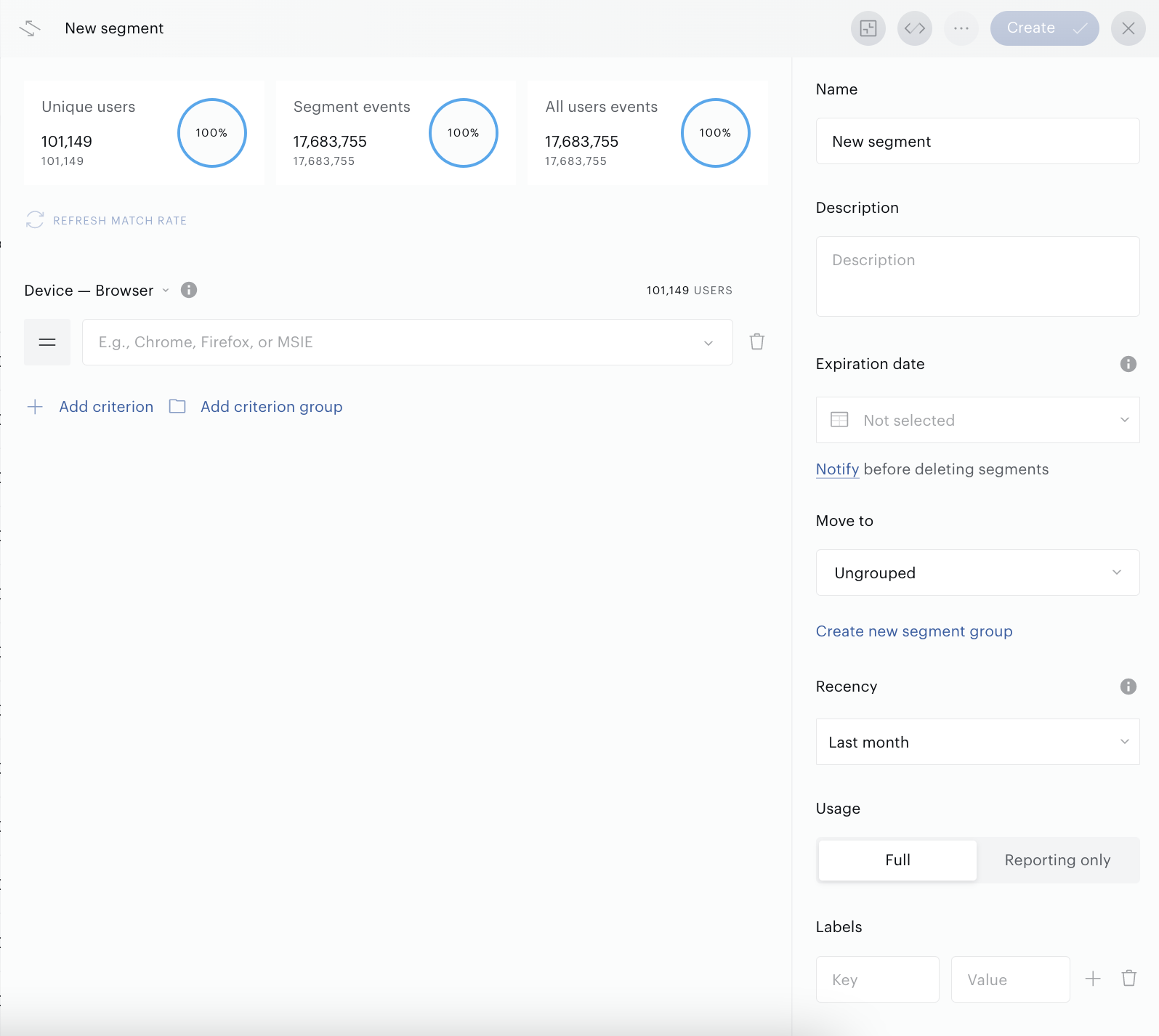
This parameter is supported in almost all types of segments, except those segments that won’t be deleted anyway, such as Internal or Sociodemographic.
The customer can define this param at any time: when the segment is created or updated. The opposite is also true. It is enough to press a “clear” link in the field and delete the previously filled value. The customer can press the Notify… link below the Expiration date parameter to be redirected to Subscriptions, where they can activate the associated event and get notifications before the segment deletion.
The Expiration date parameter has some restrictions:
-
It is impossible to set up the current date or date in the past. Use a date in the future.
-
This parameter is not supported in the Segment Builder for Internal segments or segments with non-Custom category because these segments can’t be deleted by the customer.
Bulk operation “Change expiration date”
In the segment list, there is a bulk operation Change expiration date that allows to modify this parameter for multiple segments at a time:
1. Select one, two or more segments in the Segment list.
2. Press the Change expiration date button in the footer of the page (the Bulk operations section):

3. Modify the Expiration date parameter using the bulk operation form:
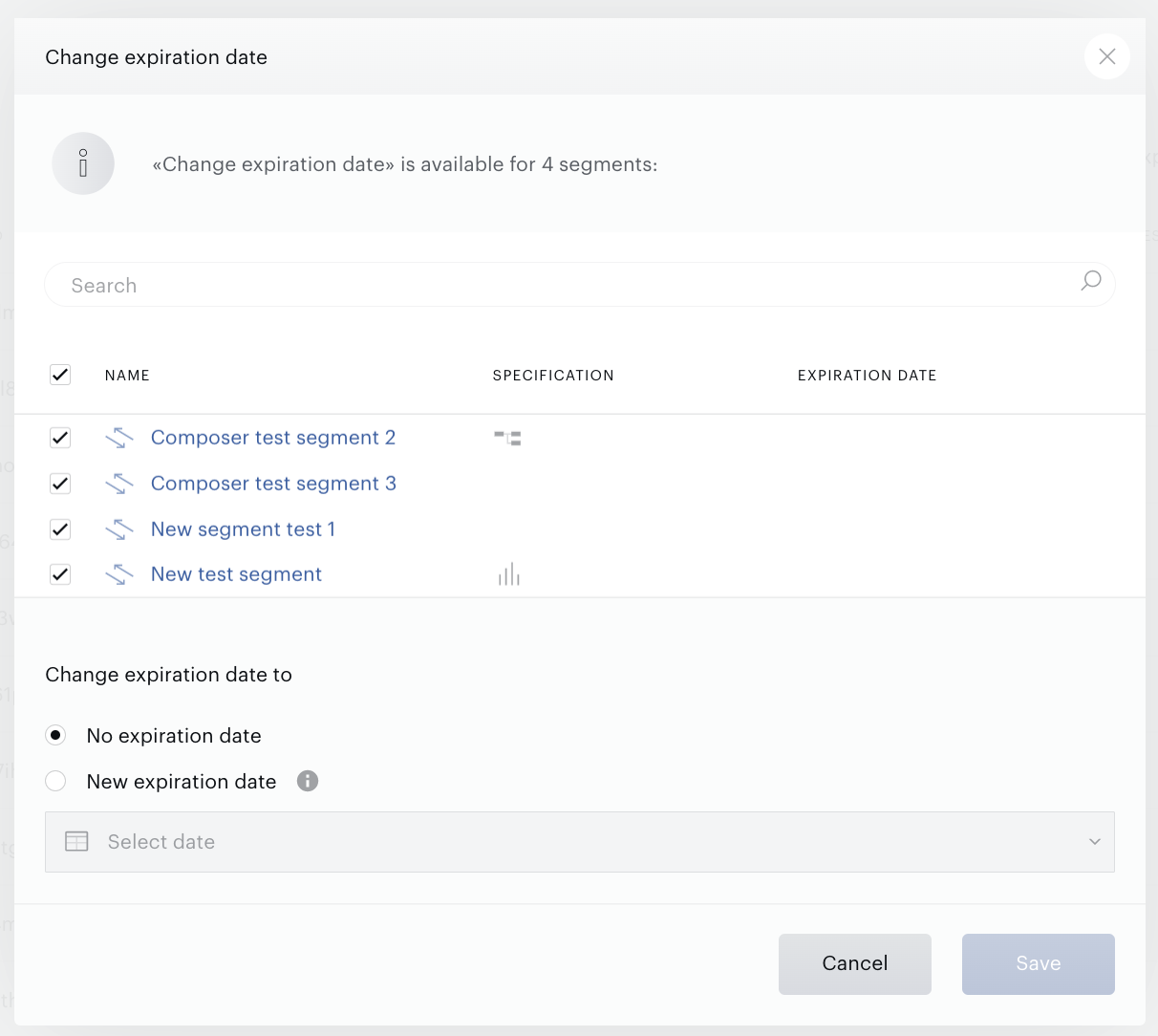
Use the No expiration date option if you want to clear the parameter. Or use the New expiration date option to set the expiration date.
4. Save changes by pressing the Save button.
How to find segments that can be deleted soon?
There are two options available in the Segment List:
-
Expiration date: a column; data can be sorted.
-
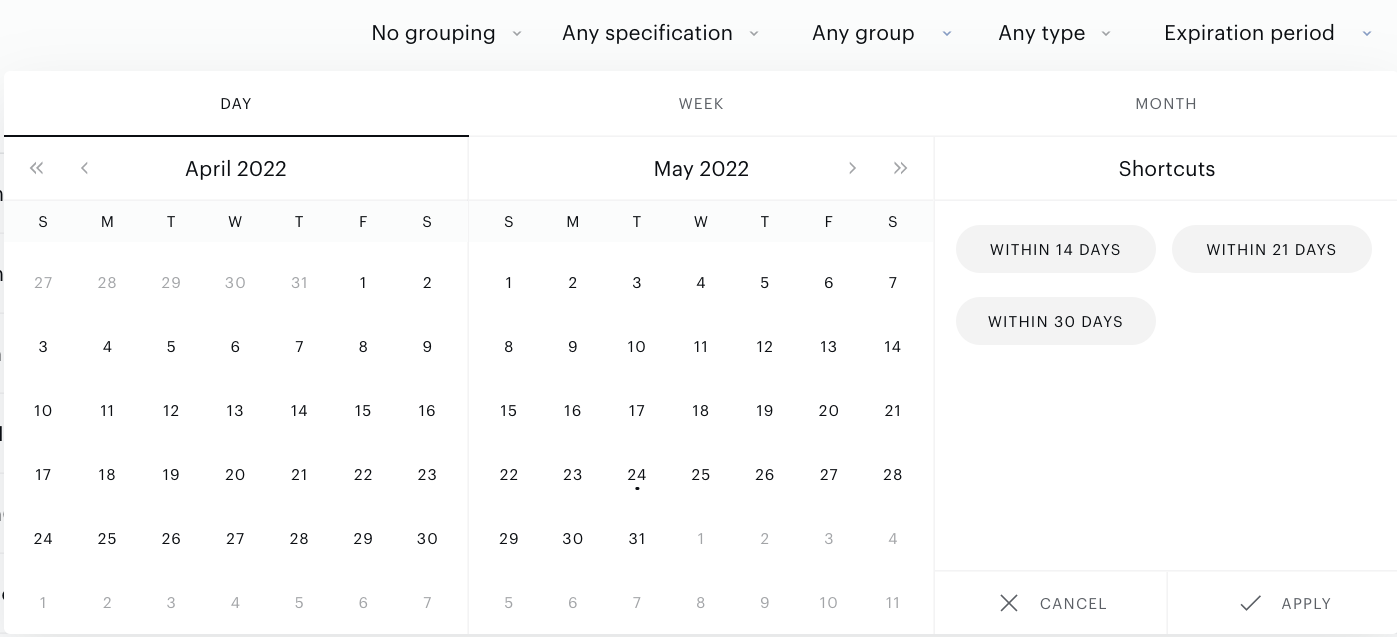
Expiration period: a filter for segments with a specific Expiration date:
Why wasn't a segment automatically deleted?
The main reasons why segments can’t be deleted automatically have been already mentioned. Piano Audience doesn’t allow to delete:
-
Internal segments.
-
Segments with non-Custom category.
-
External segments (automatic deletion can be added later).
In addition to the main reasons, at the moment of deletion the following segments can’t be deleted as well:
-
If the segment is used in an active Composer experience.
-
If the segment is being used in Modules (CCE, Content).
-
If the segment is a base segment in Lookalike segment(s) (to avoid corruption of the Lookalike segment).
-
In rare cases, the reason can be related to technical problems.
An expired Expiration date parameter will be cleared automatically. On a daily basis, Piano Audience finds segments with expired Expiration date parameter and clears such dates.
Bulk Operations with Segments
Overview
Segment Builder in Audience→Segments allows you to manage segments one by one. If the same operation should be done with the more than one segment at the same time it can be done by using Bulk operations:
-
Move to - allows to add several selected segments to the particular segment group at the same time; allows to move from one segment group to another or move out all segments from the segment group.
-
Change usage - allows to set up parameter Usage for the selected segments. You can make all selected segments Full usage or Reporting only usage.
-
Add labels - operation allows to add the same labels (key-value pairs) to the selected segments at the same time.
-
Add into connection - operation allows adding one or more selected segments to the existing connection.
-
Delete - allows one or more segments to be deleted at the same time.
-
Change expiration date - allows to set up the same Experience date for the selected segments.
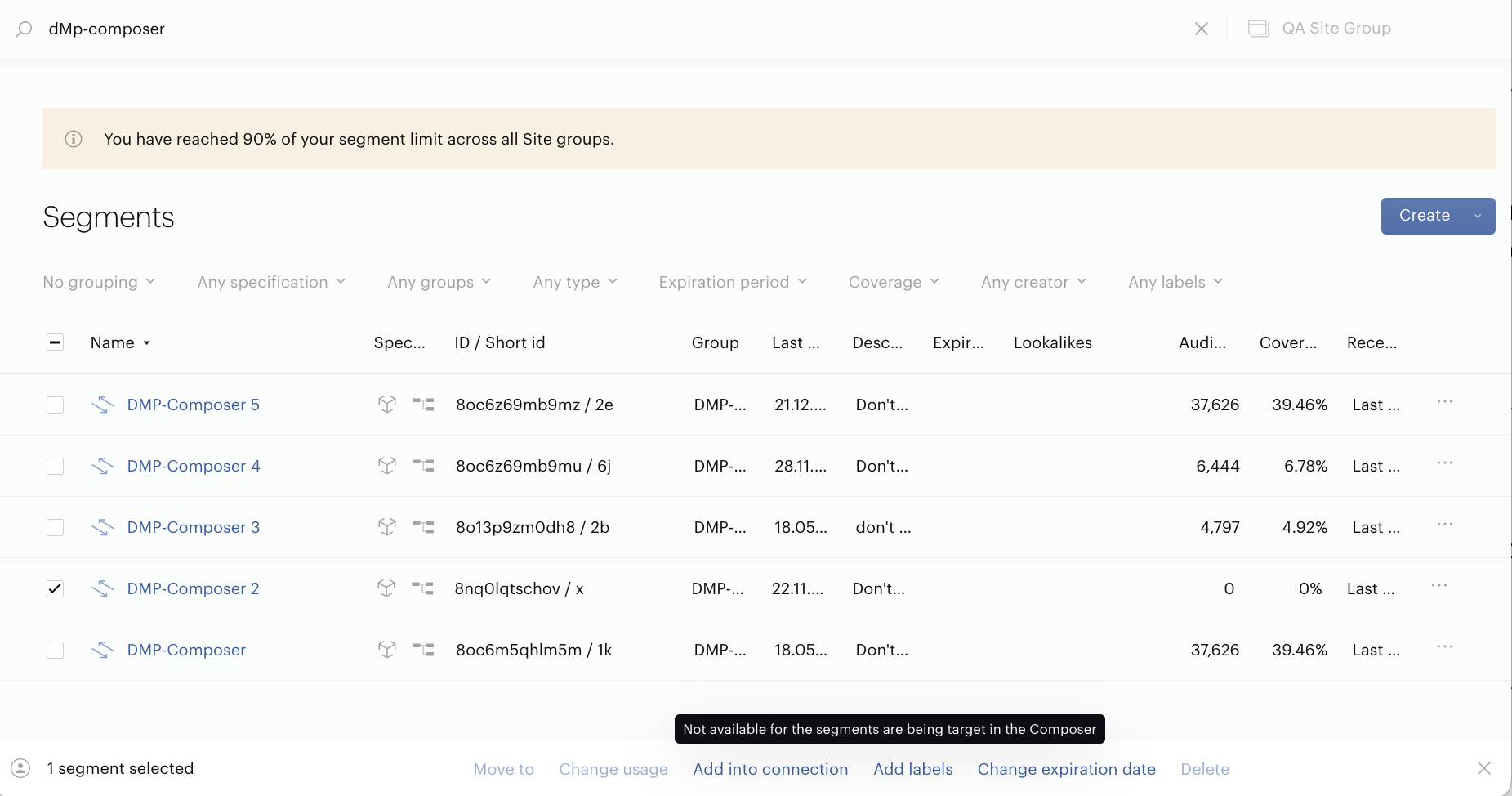
To be able to see the bulk operation menu items it is enough to choose at least one segment by using checkboxes next to the segment names in the Segment List:

If the bulk operation cannot be applied to all selected segments, the bulk menu item will be disabled with the general or specified hint text.
Move to
Using this operation you can:
-
Add segments to the selected segment group.
-
Move selected segments from one segment group to another.
-
Move selected segments out of segment group(s), using the Ungrouped option.
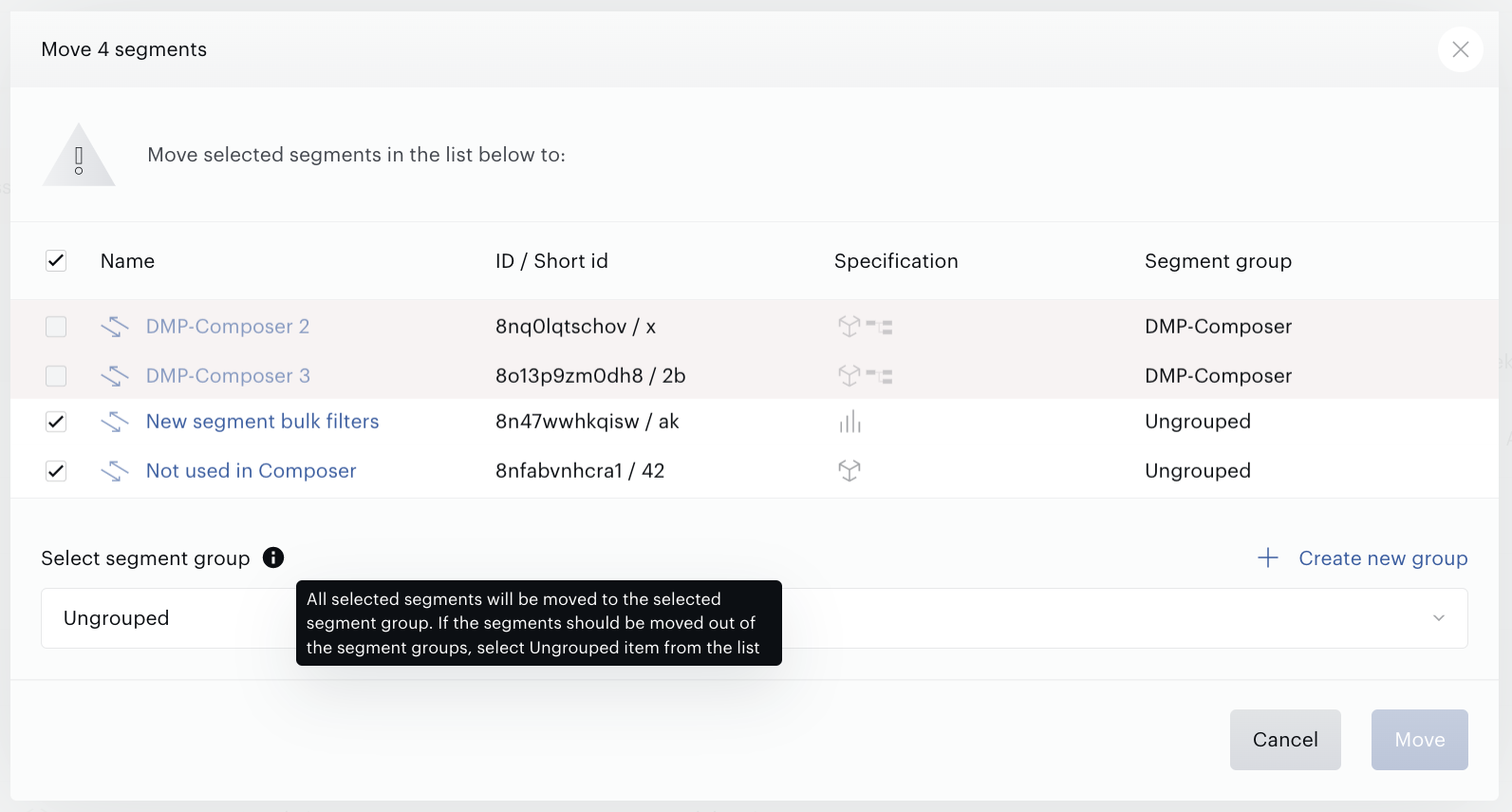
Piano Audience verifies if this operation is possible.
-
You cannot manage the Standard segment group, which means that customers can’t delete segments from the Age/Gender/etc segments groups or add other segments to these groups. Usually segments within these segment groups are Internal.
-
You cannot move segment(s) out of the segment group if the segment is used in the active Composer experience(s).
-
You cannot move segment(s) from one segment group to another if it is the same segment group.
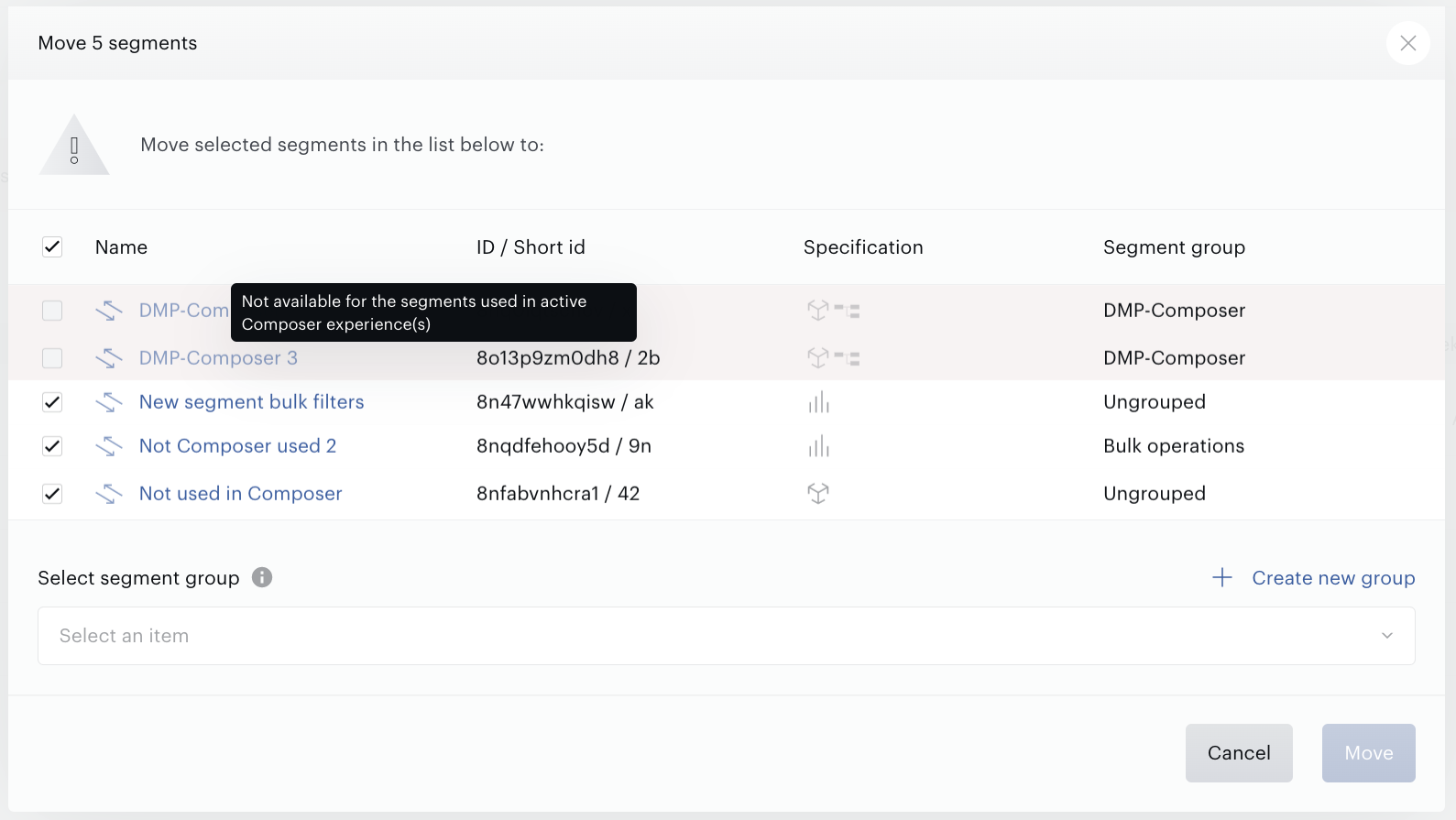
List of segment groups that can be selected as the destination segment group includes Custom segment groups and an Ungrouped option only.
If some of the segments were selected by mistake, you can deselect them right in the modal form using the checkboxes next to the segment names.
Change usage
Using this operation, you can set up the same Usage parameter for all selected segments in a list.
Piano Audience verifies if this operation is possible.
-
You cannot set up the Composer used segment Usage as Reporting only.
-
You cannot change the Usage parameter of the Internal and External segments.
-
You cannot save changes if they lead to exceeding the Customer segments limit.
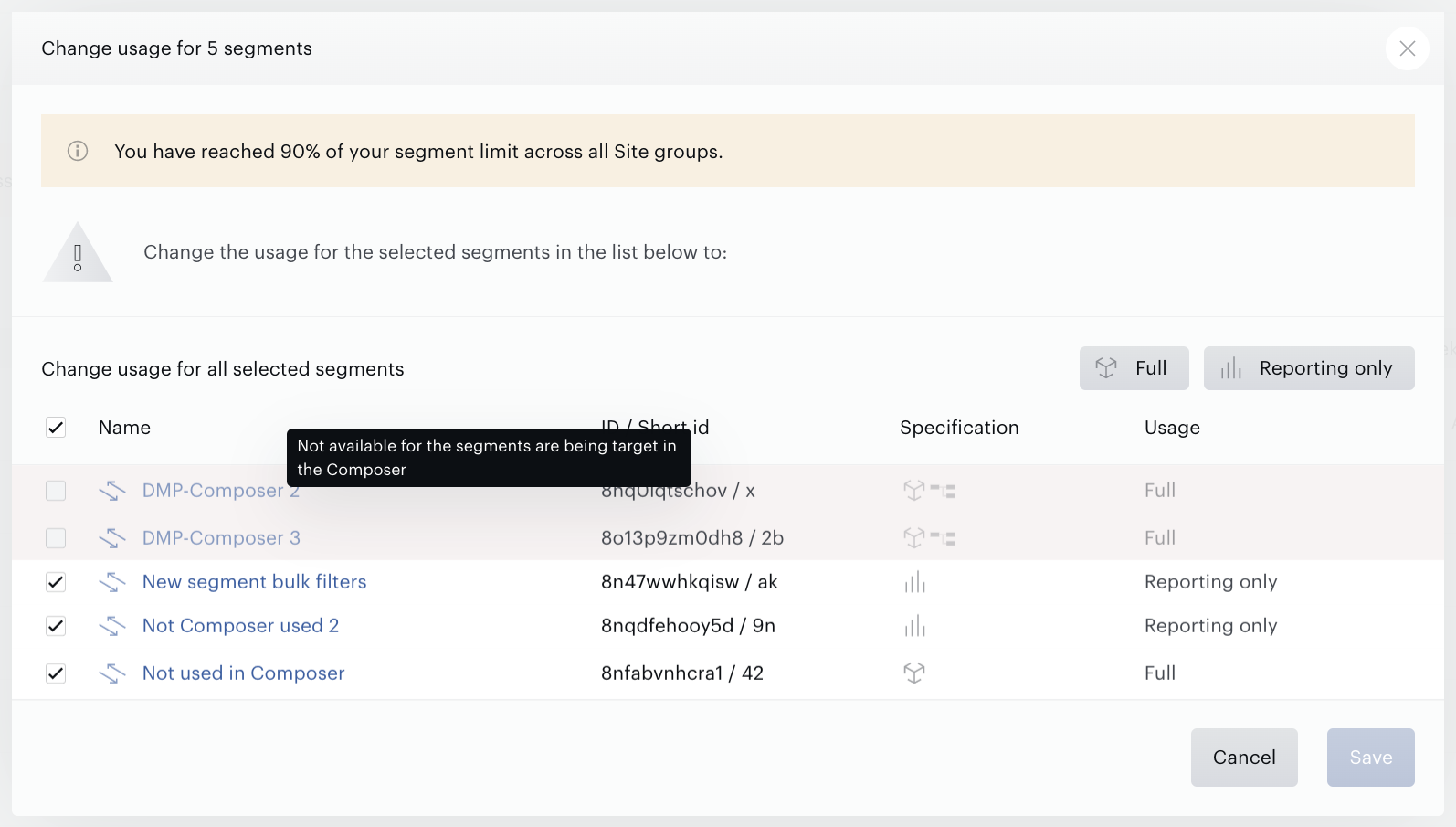
If some of the segments were selected by mistake, you can deselect them right in the modal form using the checkboxes next to the segment names.
Add labels
Labels (key-value pairs, also known as Annotations) are used for segment grouping; they can be used as an extra filter to be able to find segments faster, Labels can be exported outside and used for automatic operations, etc.
Using this operation you can add Labels (key-value pairs) to the selected segments.
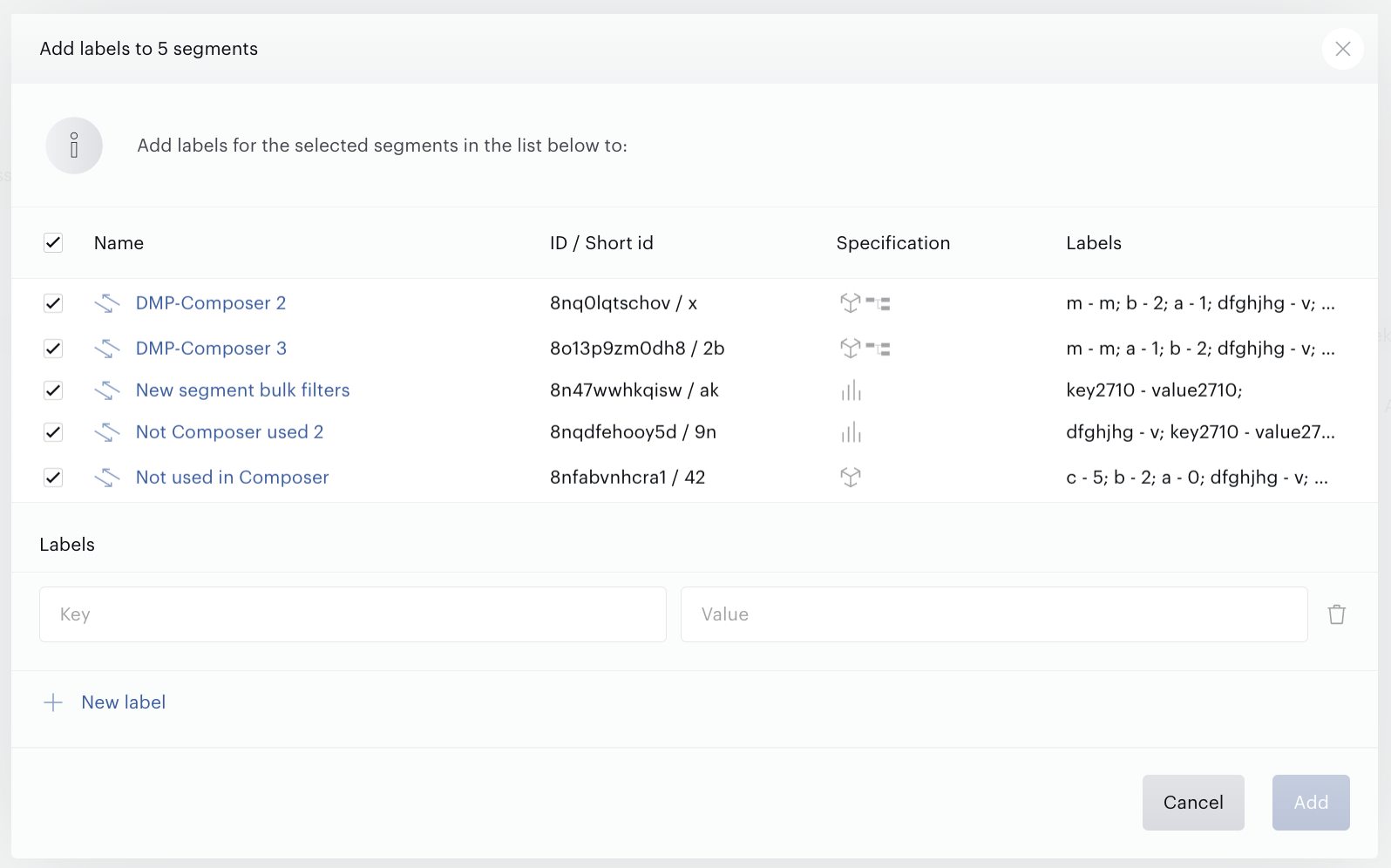
-
Key-value pairs should be correct in terms of format. It is expected to use only legal characters.
-
You cannot add the same Labels as the segment already has. Piano Audience doesn’t allow duplicate Labels in the segment.
-
You cannot update Internal segments in terms of Labels.
-
You cannot manage specific Composer used Labels.
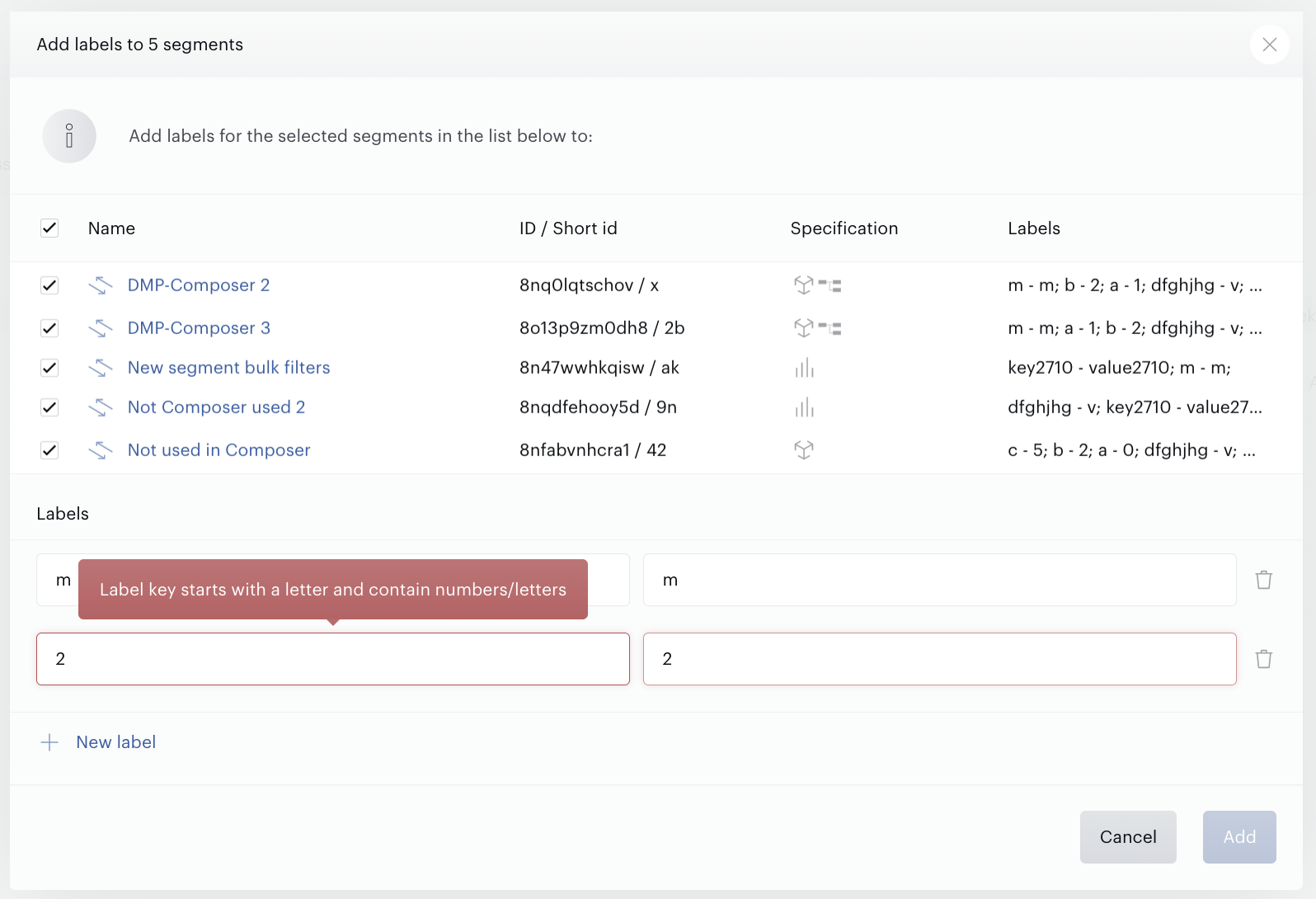
If some of the segments were selected by mistake, you can deselect them right in the modal form using the checkboxes next to the segment names.
Change expiration date
Using this operation you can manage the Expiration date parameter for all selected segments in a list: fill the Expiration date, update or even delete it and set up the same new Expiration date for the selected segments.
Piano Audience verifies if the operation can be done:
-
Expiration date is not supported for the External segments (it can be changed later) and Internal segments.
-
You cannot select the date from the past.
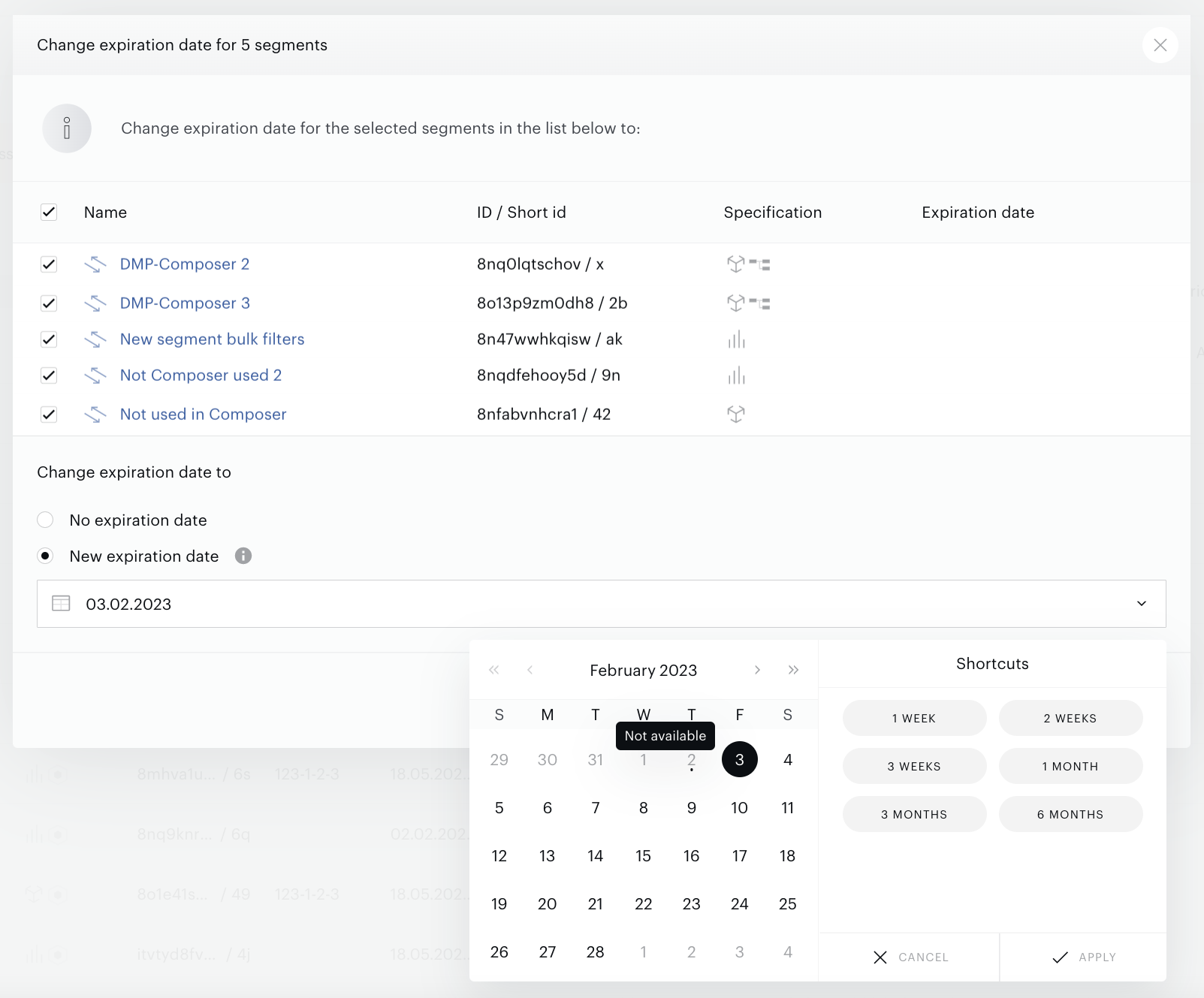
If some of the segments were selected by mistake, you can deselect them right in the modal form using the checkboxes next to the segment names.
Delete
Using this operation you can delete several selected segments at a time.
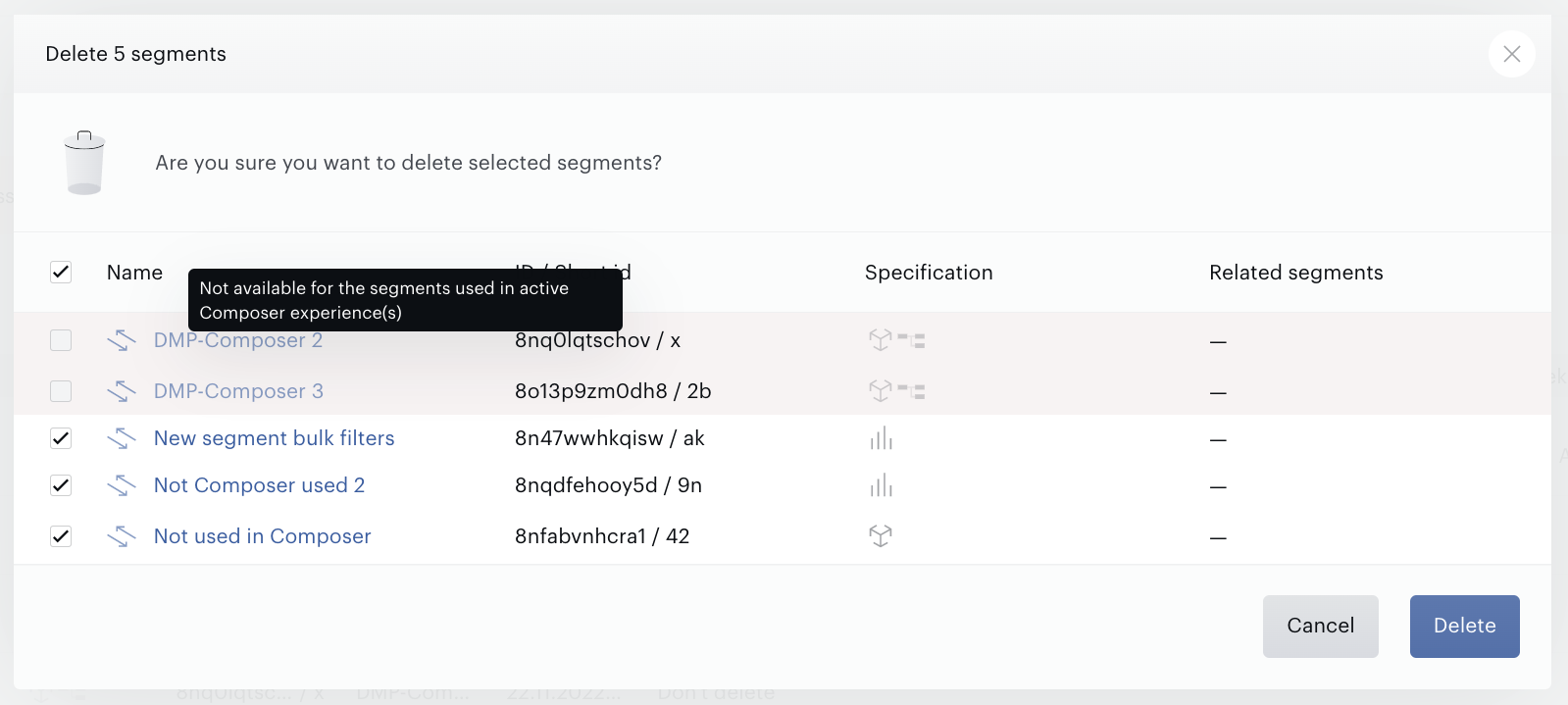
Piano Audience verifies if the operation can be done. You cannot delete the following segments:
-
Internal, or segments that are used as filter(s) in the Internal segments.
-
Segments that are used in the active Composer experience(s).
-
Segments that are used in Modules.
Piano Audience highlights segments that cannot be deleted using the red color background. Tooltips can show more details about the reasons.
If the segment that should be deleted is used in other segments as a filter for example, after deletion these segments will be updated or deleted as well. It is possible to see how segments are related to each other by pressing the See related segments link.
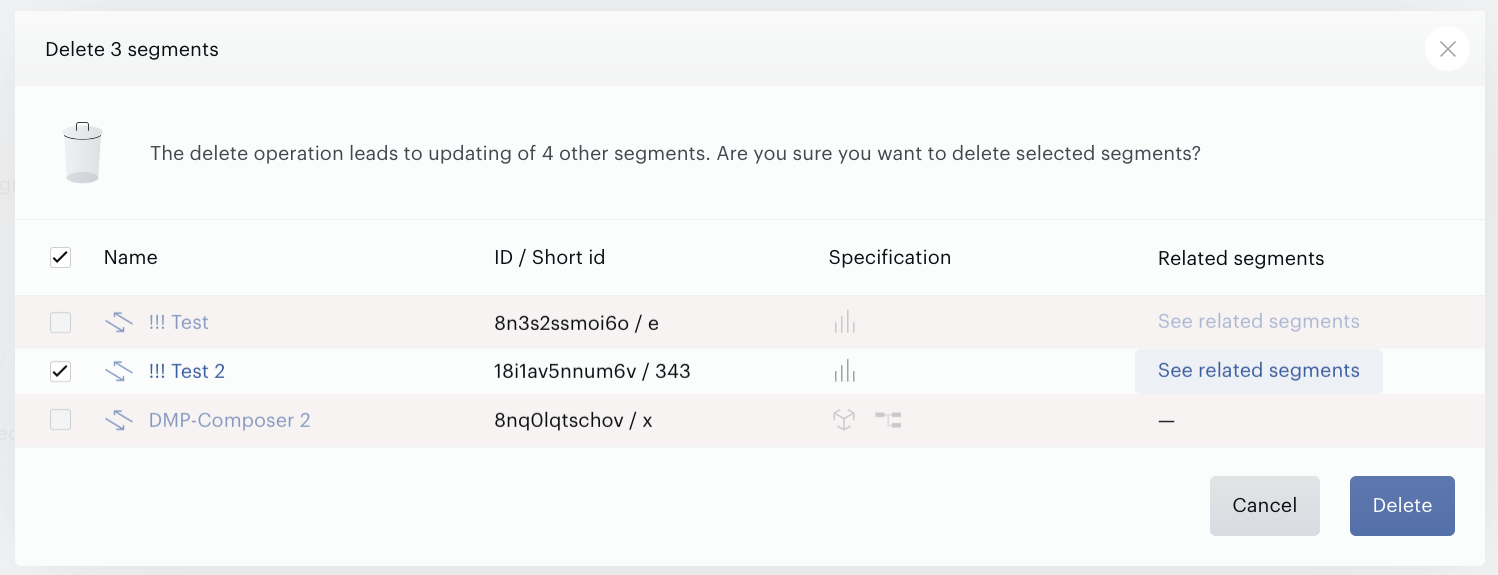
In the new modal form, the full list will be shown.
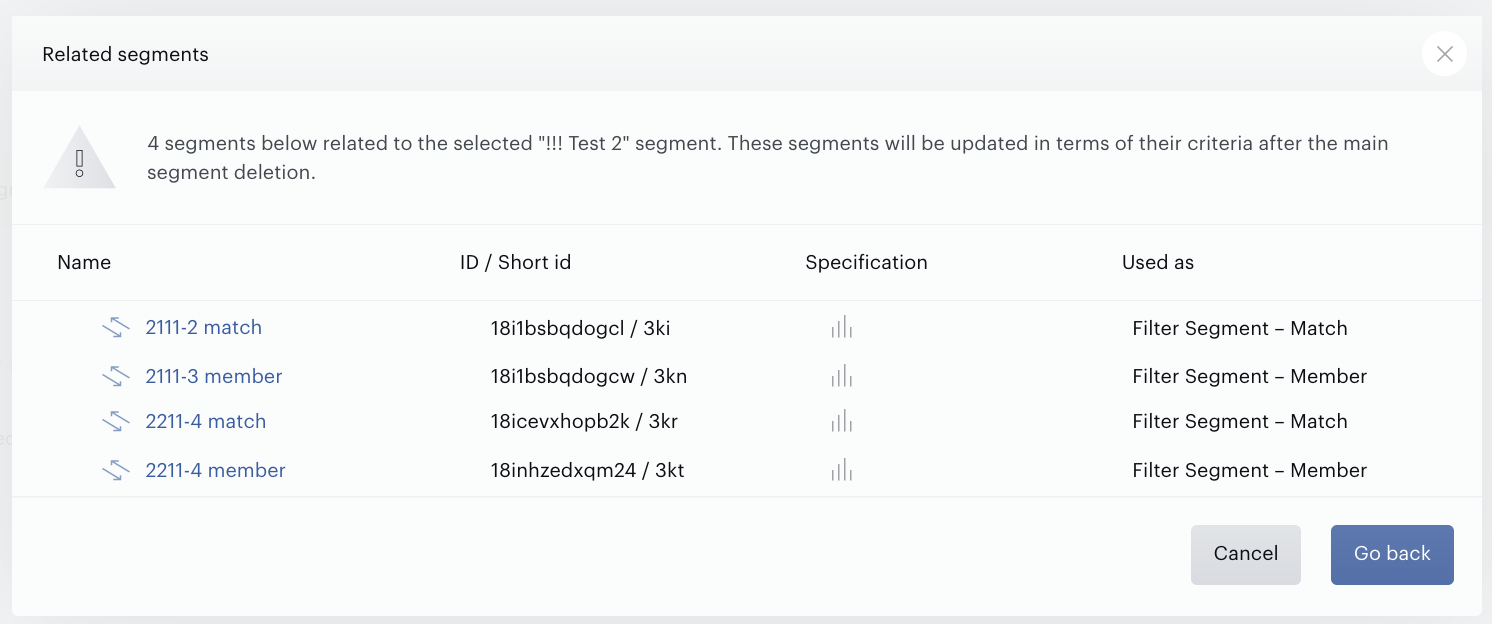
To be able to come back to the main modal form, you have to press the Go back button.
If some of the segments were selected by mistake, you can deselect them right in the modal form using the checkboxes next to the segment names.
Add into connection
Using this operation you can add several selected segments into existing connection(s).
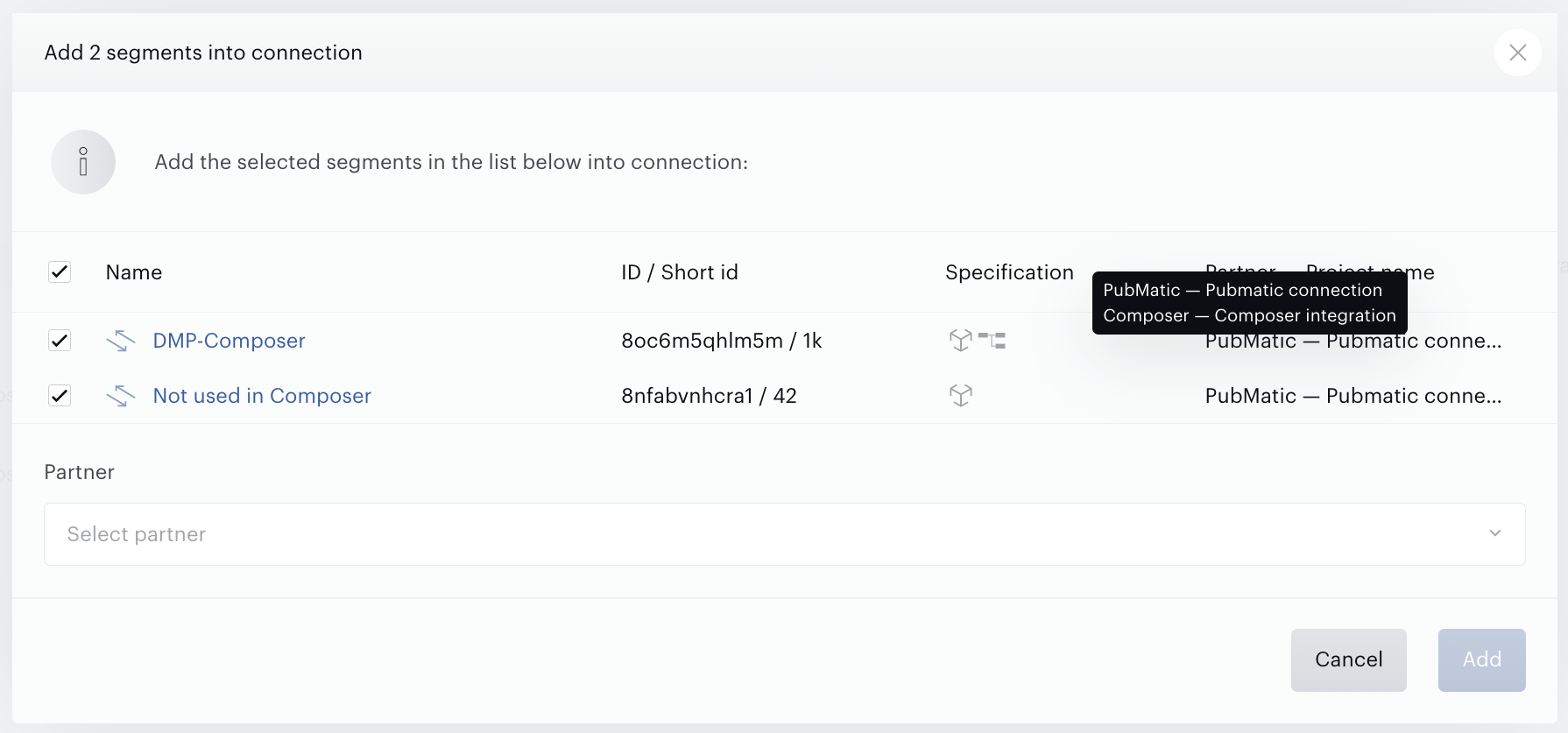
It is possible to see where the particular segment has been added already. Use the Partner-project name column and tooltips show you this information.
Audience doesn’t support this bulk operation for the Xandr (also known as AppNexus) Populating connection. Please use the connection in the Connectivity to add new segments.
Piano Audience verifies if the operation can be done.
-
You can add segments into connection if at least one connection for the selected Partner exists and if the connection status is Active.
Audience supports some restrictions if you want to add segments into the Composer connection. It is possible to add into Composer connection the following segments only:
-
If the Usage parameter equals Full.
-
Segments must be classified under a segment group.
-
The total number of segments transferred to the Composer cannot be more than the Composer limit per the site group. By default this limit equals 30 segments.
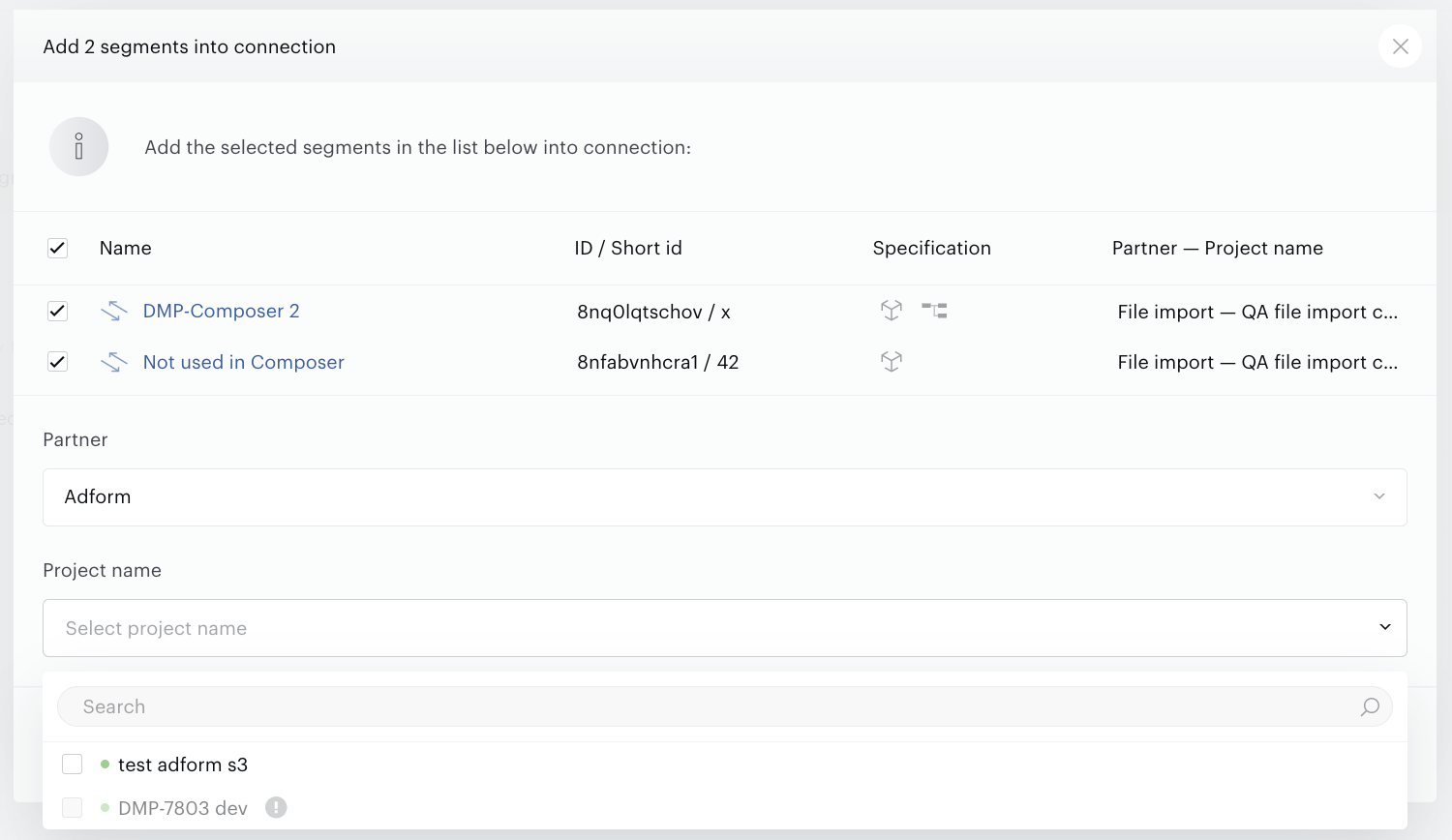
If you select segments in the Segment list and press Add into connection form, the modal form will appear. Select one of the available Partner:
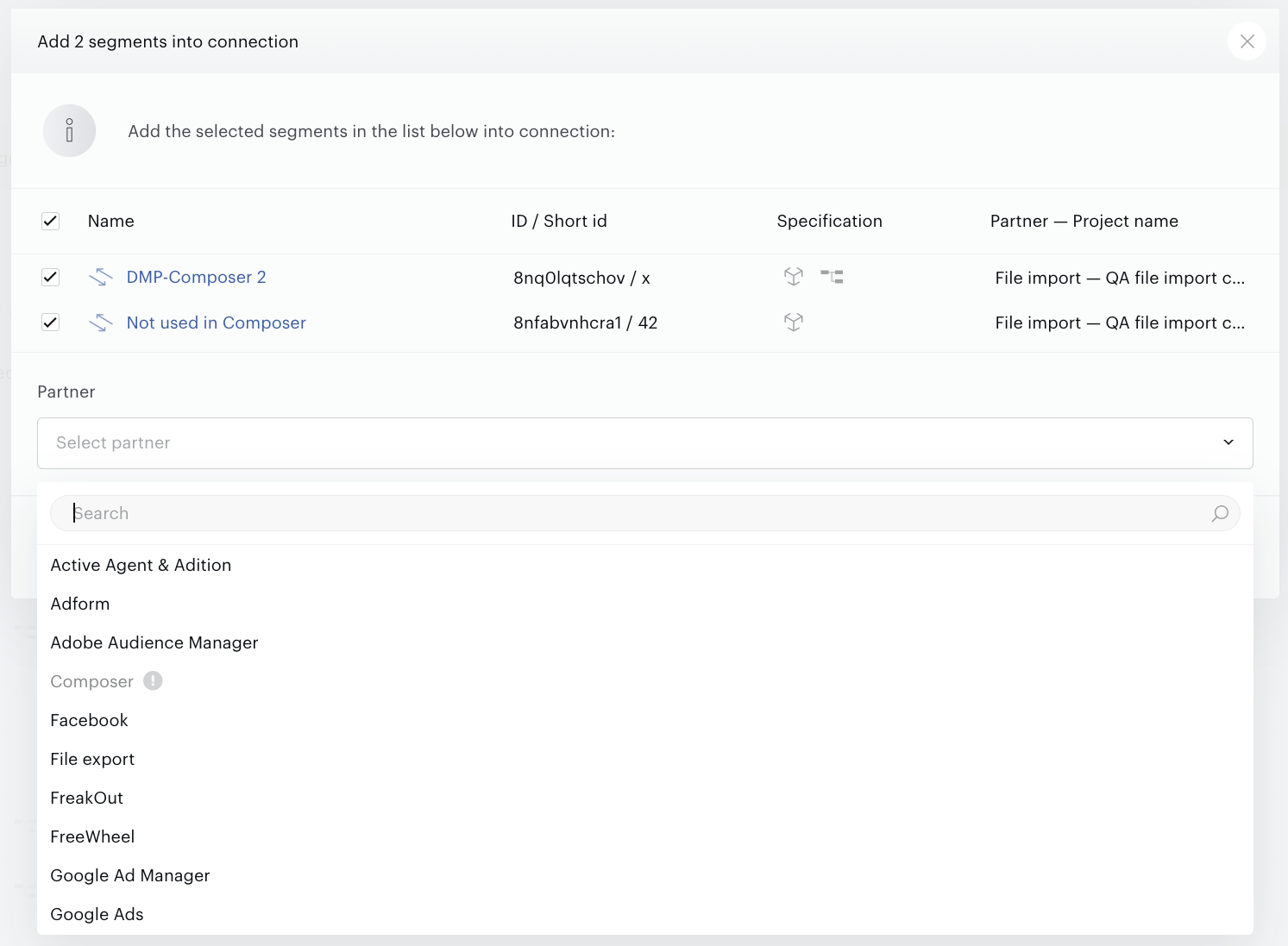
After that select at least one of the existing (earlier created in the Connectivity) connections, using the Project name selector:
Press Add button to complete the bulk operation:
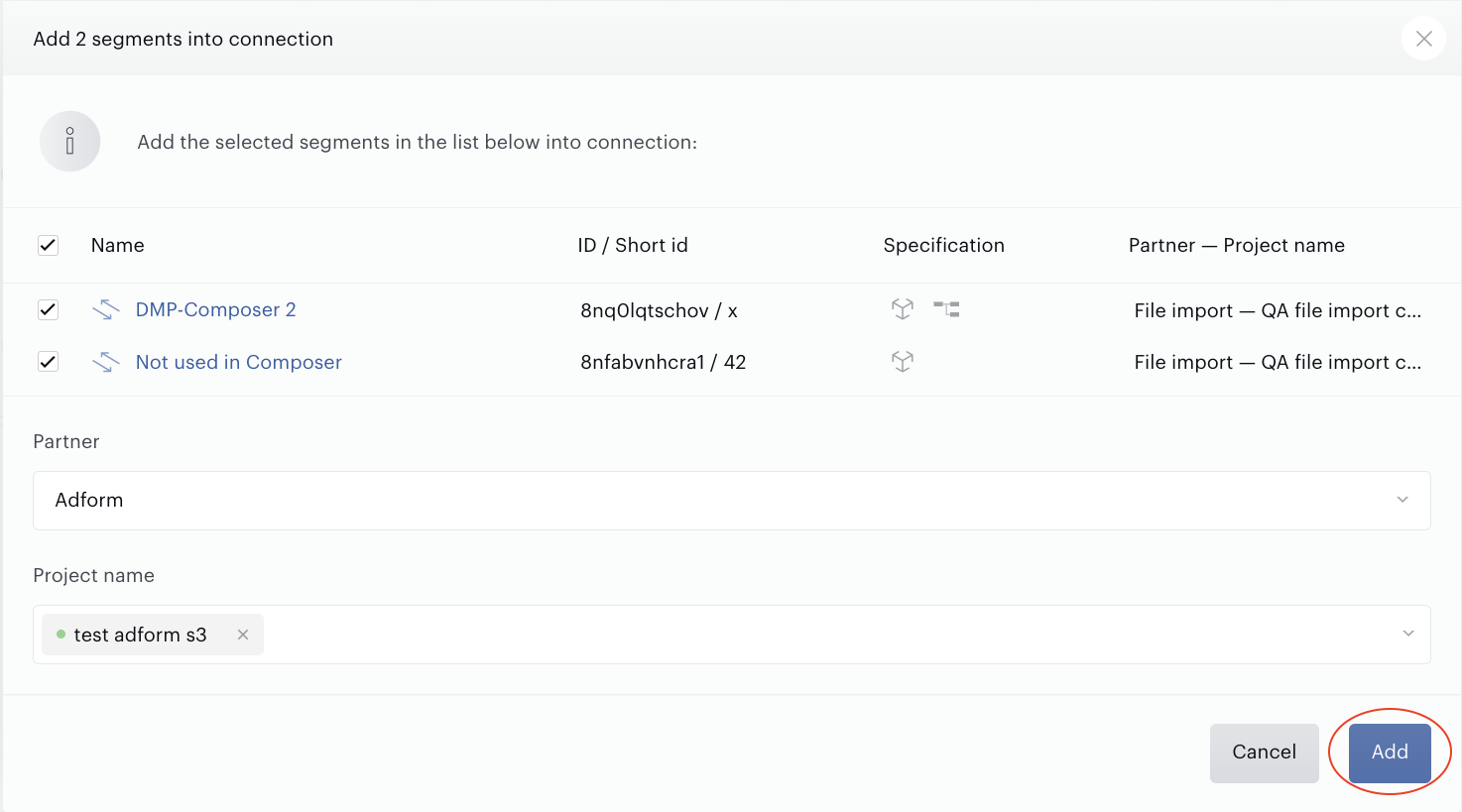
If some of the segments were selected by mistake, you can deselect them right in the modal form using the checkboxes next to the segment names.